
TAD Orthodontic Treatment: Uses, Process and Risks
How orthodontic miniscrews anchor tooth movement with braces or aligners, the 13.5% pooled failure figure, what placement involves and what a quote must cover.
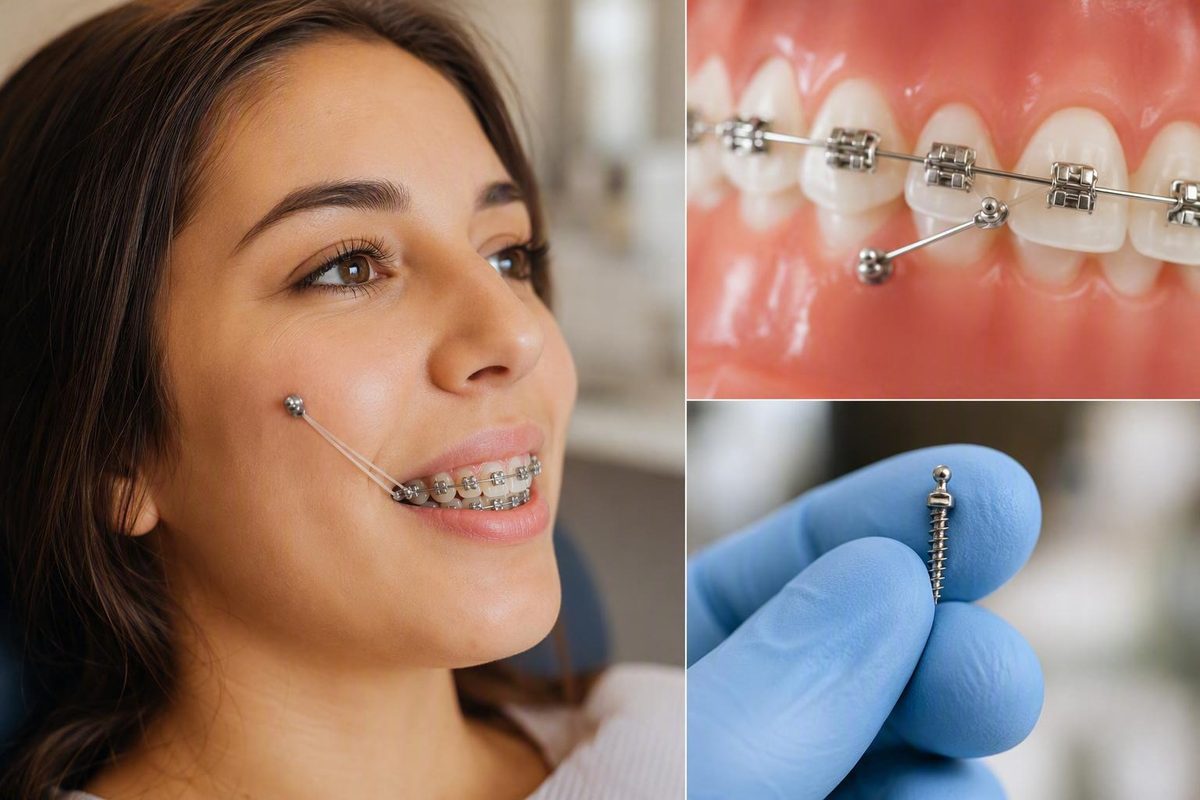
A temporary anchorage device (TAD) is a small screw fixed in the jawbone for part of orthodontic treatment, so force can be applied from a comparatively stable point instead of from other teeth. It works with braces, clear aligners or an expander rather than replacing them, and it comes out once the movement it supports is finished. It earns a place in a plan only when a specific tooth movement needs more anchorage than teeth alone can supply.
Two facts frame the decision. The best pooled failure estimate in the sources reviewed here is 13.5% across 4,987 miniscrews, from a 2012 meta-analysis whose literature search ended in February 2011. Those sources publish no standard price, so the fee has to come from a written, itemized quote.
Pick the movement your orthodontist named and who will place the device; the panel shows what the anchor does and what to ask.
Retraction of front teeth
What moves: Front teeth move backward.
What the TAD anchors: Limits forward movement of the teeth that would otherwise serve as anchors.
Without it: Teeth pulled against each other can both move, so the anchor teeth may shift forward.
Ask:
- What could happen to the back teeth if tooth-based anchorage were used instead?
- Where would it be placed, and what imaging will check nearby roots and anatomy?
- Are placement, monitoring and removal all inside the orthodontic fee?
- What is the plan if the device loosens or cannot be used?
Check what your written quote covers
0 of 10 confirmed in writing.
Ask about every item above before agreeing. Typical fee: — (the reviewed sources publish no standard price range).
All six movements at a glance
| Movement | What moves | What the TAD anchors |
|---|---|---|
| Retraction | Front teeth move backward | Limits forward movement of would-be anchor teeth |
| Intrusion | A tooth or group moves farther into supporting bone | Supports vertical movement, e.g. selected molars in some open-bite plans |
| Space closure | Teeth move into an extraction or missing-tooth space | Anchors the closing force; does not replace a missing tooth |
| Distalization | Teeth, often molars, move toward the back | Helps avoid pulling other teeth the opposite way |
| Molar uprighting | A molar's angle or position is corrected | Avoids relying exclusively on nearby teeth |
| Impacted tooth | An unerupted or displaced tooth is guided toward the arch | Provides anchorage while the tooth is guided |
Failure evidence: pooled 13.5% (95% CI 11.5–15.8%) across 4,987 miniscrews, literature search to Feb 2011; not a personal risk estimate. Sources: clinical review of TADs (PMC10544606), Ohio State thesis on TAD use, AAOMS patient overview, 2012 meta-analysis (PubMed 23116500). General information, not clinical advice.
A TAD Is a Temporary Bone Anchor, Not an Implant
A TAD, also called an orthodontic miniscrew or mini-implant, exists for one purpose: anchorage. That means limiting unwanted movement in one area while another tooth or group of teeth is moved.
Two teeth joined by an elastic pull on each other. Both can move, even when the plan calls for only one to move. Tying the force to bone gives the orthodontist more control over the target movement.
The anchorage can be direct or indirect. In direct anchorage, a spring, elastic, wire or similar component runs from the TAD to the teeth being moved. In indirect anchorage, the TAD stabilizes one or more teeth, and those teeth act as the working anchor.
A clinical review of temporary anchorage devices describes them as temporary bone-based devices used for direct or indirect anchorage and removed after serving that purpose. The same review explains that orthodontic miniscrews rely mainly on mechanical retention, not the long-term integration expected of a prosthetic dental implant.
A prosthetic implant supports a replacement tooth. A TAD does not fill a missing-tooth space, replace a tooth or become the final restoration. Braces or aligners still guide the broader treatment; the TAD supplies extra anchorage where one movement requires it.
Six Tooth Movements Where Bone Anchorage Is Used
A recommendation should be tied to a particular movement, not only to a diagnosis name such as an overbite or open bite. Two people with the same named bite problem can have different anatomy, treatment goals and anchorage needs.
- Intrusion: moving a tooth or group of teeth farther into the supporting bone, such as selected molars in some open-bite plans.
- Retraction: moving front teeth backward while limiting forward movement of the teeth that would otherwise serve as anchors.
- Space closure: moving teeth into an extraction space or a space associated with a missing tooth.
- Distalization: moving teeth, often molars, toward the back of the mouth.
- Molar uprighting or movement: correcting a molar’s angle or position without relying exclusively on nearby teeth.
- Impacted tooth assistance: providing anchorage while an unerupted or displaced tooth is guided toward the dental arch.
Academic literature describes these and related uses, including anterior retraction, intrusion, space closure, molar movement, molar uprighting and help with impacted teeth (Ohio State University thesis on TAD use and clinical protocols).
The accessible head of the screw connects to springs, elastics, wires or related components. TADs can be built into treatment with fixed braces or clear aligners and can form part of selected expander designs. Compatibility with an appliance does not establish that a given device or placement site suits you. The orthodontist still has to assess the intended biomechanics, available bone, tooth roots, gums and overall diagnosis.
A TAD Does Not Replace Jaw Surgery
A TAD supplies anchorage for tooth movement. It should not be presented as a general substitute for corrective jaw surgery when the main problem is a large skeletal discrepancy between the jaws. One orthodontic practice’s patient guide to TAD orthodontics makes the same qualified point: large jaw discrepancies may still need a surgical plan.
The Pathway Runs From Records to Removal
Details vary by patient, device and care team, but a TAD-assisted plan generally follows this sequence.
- Examination and records. Bite, tooth positions, goals, dental and health history; records may include photographs, scans or impressions, and X-rays.
- Defining the movement and the anchorage need. Which teeth move, in what direction, and which should stay comparatively stable. This is where TAD anchorage is compared with tooth-based anchorage, elastics, headgear or other mechanics.
- Assessing the proposed area. Available bone, nearby roots and other structures, soft tissue, oral hygiene and periodontal health.
- Imaging the site. The type depends on the location and the anatomical questions to be answered.
- Informed consent. Purpose, location, expected course, alternatives, possible problems, home care, and what happens if the device loosens.
- Placement. The technique depends on the device design and the site.
- Connection to the mechanics. The TAD is loaded directly or indirectly. Loading schedules vary, and the available evidence does not justify treating immediate or delayed loading as universally preferable.
- Monitoring. The device, surrounding tissue, attached components and progress of the movement are checked.
- Removal. The TAD comes out when its anchorage role is complete, which may be before the rest of orthodontic treatment ends.
These planning elements, from bone and root evaluation through imaging, consent, monitoring and removal, are described in the clinical review cited above.
Anesthesia, Staffing and Device Design Are Not Fixed
Local anesthesia is commonly described for placement. Sedation, the placement method and which professional performs the procedure can vary. An oral and maxillofacial surgeon may place a TAD as part of a coordinated plan, but that is not the only staffing arrangement, and removal practices and patient experiences also differ (American Association of Oral and Maxillofacial Surgeons’ TAD overview).
Design and location are not interchangeable details. A miniscrew placed between tooth roots raises different planning questions from one placed farther from roots. Palatal and other specialized anchorage systems may use different components and techniques, so instructions given to someone with another device or site may not apply to you.
Two operational questions belong before consent: who will place and remove the TAD, and what imaging will be used to assess the site and nearby anatomy. Be wary of promises that placement or removal always takes a fixed number of minutes, is painless or needs no recovery.
“Compliance-Free” Describes the Anchor, Not the Patient
TAD anchorage is sometimes called compliance-free. The phrase has a narrow meaning: the bone anchor does not depend on you wearing an external anchorage appliance such as headgear. The rest of treatment still depends on you.
While the device is in place you may still need to clean carefully around the screw head and connected components, attend monitoring and adjustment visits, wear aligners on the prescribed schedule, use elastics as instructed, and report mobility or persistent discomfort.
Follow the cleaning method your treating team demonstrates. Device designs and locations differ, so another patient’s brushing frequency, special brush, rinse, medication or diet may not apply to you. Medication instructions should come from a professional who knows your procedure and health history. The AAOMS patient guidance emphasizes oral hygiene and following the postoperative instructions given for the specific device.
Before placement, settle the practical points: temporary eating restrictions, which brush or tool to use around the device, whether a prescribed rinse is needed, which symptoms are expected and for roughly how long, whom to contact outside office hours, and whether TAD-specific appointments are added to ordinary orthodontic visits.
Pooled Failure Was 13.5% in Studies Through Early 2011
Problems described in the TAD literature include mobility or loss of stability, failure to provide the required anchorage, inflammation, infection or peri-implant tissue problems, soft-tissue irritation or tissue covering part of the device, fracture, contact with a nearby root or other structure, and persistent pain.
Older academic literature discusses inflammation, infection, excessive mobility, fracture, soft-tissue irritation or coverage, and injury to nearby teeth or structures as possible complications (academic review and survey of TAD use). Problems are not confined to one stage: the American Association of Orthodontists’ professional education overview states that TAD side effects and complications can occur during insertion, clinical use or removal (AAO overview of TAD risks and complications).
A 2012 systematic review and meta-analysis covering 4,987 orthodontic miniscrews reported a pooled failure rate of 13.5%, with a 95% confidence interval of 11.5% to 15.8%. Its literature search ended in February 2011 (PubMed abstract of the miniscrew failure meta-analysis).
That figure is historical evidence, not a personal prediction. It is not a current universal failure rate, and it does not mean every patient has a 13.5% chance of failure. The included studies differed in clinical circumstances and definitions, and a pooled estimate cannot account for your device, placement site, anatomy, oral health, clinician or current methods.
A Loose TAD Gets Assessed, Not Ignored
Contact the treating team if the device becomes mobile or causes persistent pain, and follow its instructions for inflammation or damaged attachments. A loose TAD does not necessarily mean the whole orthodontic treatment has failed. Depending on the circumstances, the team may monitor it, reposition or replace it, remove it, or change the mechanics. The response turns on whether the device can still provide the intended anchorage and whether surrounding tissues or structures are affected.
Words such as safe, predictable, painless or minimally invasive are not guarantees. A useful consent discussion covers the risks of the proposed location, the steps taken to reduce them, the changes you should report, and the backup plan if the device cannot be used as intended.
No Anchorage Method Wins Every Case
The meaningful comparison is not modern versus old. It is which source of support fits the required movement, anatomy, treatment design and patient priorities.
| Option | Support Comes From | Your Part | Main Limit |
|---|---|---|---|
| TAD | Screw temporarily fixed in bone | Added placement and removal; cleaning | Bone, roots, soft tissue, stability |
| Tooth-based | Other teeth or dental units | Usually built into the appliance | Anchor teeth can move reciprocally |
| Headgear or similar | External appliance, when worn | Wear time and correct use | Fit, consistency, lifestyle |
Tooth-based anchorage avoids a separate bone-anchor procedure, but its usefulness depends on the teeth available and how much reciprocal movement the plan can tolerate. Cooperation-dependent anchorage works only when the appliance is worn as directed.
TADs may reduce reliance on headgear in selected cases. They do not guarantee that headgear, extractions, expansion, prosthetic implants or jaw surgery can be avoided, because those options may address different diagnostic or mechanical problems.
Time in Place Varies and No Standard Price Is Published
A TAD may stay in for months or longer, depending on how long its anchorage is needed. It may come out before the rest of treatment ends or stay useful through a longer part of the plan. No single duration applies to every patient.
The reviewed evidence does not establish that adding a TAD routinely shortens total treatment or reduces the number of appointments. It may make a particular movement possible or change how that movement is controlled, which is not the same as a shorter schedule.
The reviewed sources give no reliable standardized price range. One practice’s patient guide addressing TAD duration and variable cost says cost varies by case and states no general price. The practical route is a written, itemized quote.
That quote should say whether it covers examination and records, site-planning imaging, local anesthesia or proposed sedation, placement of each device, the springs, elastics or wires connected to it, routine and TAD-specific monitoring, removal, replacement or repositioning if the device loosens, services by a separate clinician, and follow-up after removal. If another professional places or removes the device, ask whether that office bills separately, and how an unplanned replacement or change in mechanics could affect schedule and total cost.
Questions to Settle Before Consenting
- What exact tooth or group of teeth needs to move, and in which direction?
- Why is bone anchorage preferred for that movement, and what could happen with tooth-based anchorage instead?
- Where would the TAD be placed, why there, and what imaging will check nearby roots and anatomy?
- Who will place, activate, monitor and remove it, and what anesthesia or sedation is proposed?
- When will orthodontic force be connected, and how long is the device expected to stay?
- How should this particular device be cleaned, and are there eating or activity restrictions?
- Which symptoms are expected, and which should be reported?
- What alternatives exist, and what are their trade-offs?
- What is the plan if the TAD loosens or cannot be used, and could that alter the schedule?
- Which charges are included, and which could be billed separately?
A TAD is an anchorage decision, not a new type of braces or aligner. Suitability, duration, expected outcome and cost for a specific mouth can only come from the treating orthodontist.