
Palatal Expansion: How It Works as the Jaw Matures
Mini-implant-supported expansion may be considered for some adults, but predictable skeletal widening without surgery isn't possible for everyone.
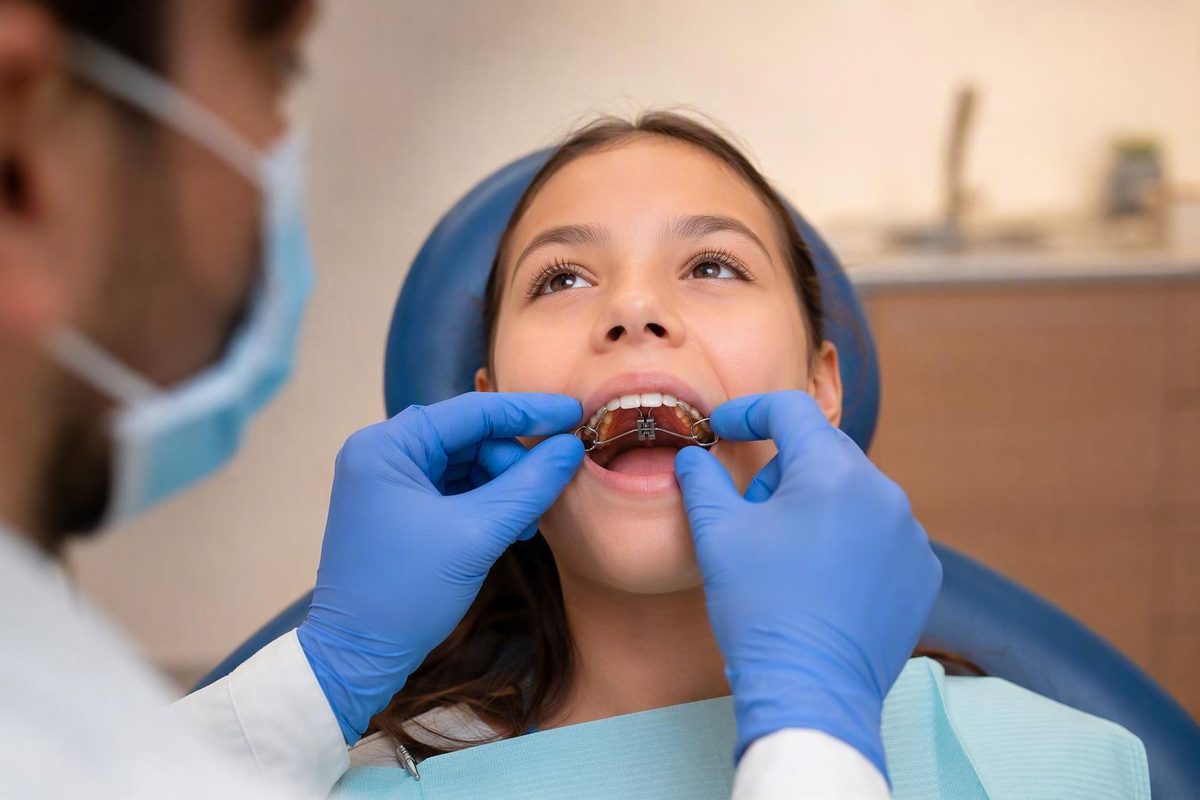
Palatal expansion is an orthodontic treatment used to widen an upper jaw that is too narrow relative to the lower jaw. It may improve how the teeth fit together and, in selected cases, create room for teeth to erupt or be aligned.
This is an introductory patient guide, not a complete framework for diagnosing or selecting treatment. The supplied evidence supports a broad explanation of how expansion works, common appliance categories, treatment stages, and daily care. It does not establish detailed contraindications, comparative success rates, long-term relapse rates, or validated selection rules for adults.
Not every crowded smile or narrow-looking dental arch needs an expander. The central question is not simply, “Can this arch be made wider?” It is, “Is the upper jaw itself too narrow, and what kind of change is appropriate for this patient’s growth stage, anatomy, and treatment goals?”
That distinction affects appliance choice, treatment time, expected discomfort, invasiveness, and whether the result is expected to come mainly from jaw widening, tooth movement, or a mixture of both. It also puts claims about avoiding extractions or improving breathing into context: either may be possible in selected cases, but neither is guaranteed.
What palatal expansion changes—and what it does not
The upper jaw is called the maxilla. Palatal expansion uses controlled force to widen a maxilla that has been diagnosed as too narrow.
The palate develops in two halves that meet at the mid-palatal suture, a joint running along the center of the upper jaw. In an appropriate patient, controlled pressure can move those halves apart. New bone then forms in the expanded area, which is why the appliance generally remains in place after active widening has ended. Cleveland Clinic’s patient guide to palate expanders describes the separation, bone-formation, and stabilization process.
It helps to distinguish two related changes:
- Skeletal expansion aims to increase the width of the maxilla itself.
- Dental expansion primarily moves or tips the upper teeth outward, increasing dental-arch width without producing the same amount of underlying jaw change.
The distinction is not always absolute. A tooth-supported expander may produce both skeletal and dental effects. The balance can vary with growth stage, skeletal maturity, anatomy, anchorage, appliance design, and the treatment plan. An increase in measured arch width should not automatically be interpreted as entirely new skeletal width.
Braces and clear aligners can also move teeth outward. That may be appropriate when the problem is mainly dental, but tooth movement is not automatically equivalent to skeletal widening when the diagnosis is a narrow maxilla. Conversely, a skeletal expander should not be used merely because an arch looks narrow if controlled tooth positioning can address the actual problem.
Crowding alone does not settle the question. Two people may both have overlapping upper teeth, yet one may have a genuine upper-jaw width deficiency while the other has an acceptable jaw relationship but large, rotated, tipped, or poorly positioned teeth.
Candidacy therefore requires an orthodontic assessment of the bite, jaw relationship, tooth positions, anatomy, growth, and treatment goals. A photograph, mirror view, or single symptom cannot establish whether the problem is skeletal, dental, or mixed.
Why an orthodontist may recommend expansion
A recurring reason for a palatal-expansion evaluation is a posterior crossbite. In this pattern, one or more upper back teeth sit inside the corresponding lower teeth when the mouth closes rather than fitting outside them. A crossbite can be dental, skeletal, or mixed, so it prompts investigation rather than automatically proving that an expander is required.
An orthodontist may also investigate upper-jaw width when there is:
- Severe crowding or inadequate room for alignment.
- Insufficient space for permanent teeth to erupt.
- An impacted tooth whose path is blocked.
- Overlapping teeth associated with limited arch space.
- A mismatch between the upper and lower jaws.
- Chewing difficulty associated with the bite.
- Other forms of bite misalignment.
The American Association of Orthodontists identifies crossbite, severe crowding, and impacted teeth among the common reasons expansion may be considered, while emphasizing that not every orthodontic patient needs it. Its overview of palatal expanders also describes evaluation, placement, controlled force, monitoring, and stabilization as separate parts of treatment.
Creating width can provide useful space, but space creation is not the same as complete tooth alignment. Overlapping teeth may still require braces or aligners. The final tooth positions must still be planned in three dimensions.
Expansion may reduce or change the need for extractions in selected patients, but it cannot guarantee that no teeth will be removed. Creating width where the jaw is genuinely deficient is different from expanding beyond the intended anatomy solely to avoid an extraction.
Nor does any one visible sign establish candidacy. Crowding, an impacted tooth, mouth breathing, snoring, a narrow smile, or chewing difficulty can each have more than one cause. A person may need an orthodontic evaluation without ultimately needing palatal expansion.
A useful consultation should clarify:
- Is the upper jaw narrow relative to the lower jaw?
- Is the problem skeletal, dental, or mixed?
- Is expansion intended to correct the bite, create space, facilitate eruption, or address several goals?
- How much of the expected change is intended to come from the jaw versus the teeth?
- What treatment is likely to be needed after expansion?
- What findings would cause the plan to be reconsidered?
The more clearly the recommendation connects the appliance to a diagnosed problem, the easier it is to assess the expected benefits and limits.
Age matters, but skeletal maturity matters more
Conventional palatal expansion is most closely associated with children because their facial bones and sutures are still developing. Applying expansion forces during growth may produce a greater skeletal response than the same tooth-supported approach after skeletal maturation.
Cleveland Clinic reports that orthodontists often begin expansion at about age seven or eight, but this is a common clinical timeframe rather than a universal starting age or a rule that every child that age needs treatment. Some children need only monitoring, while others may be evaluated earlier or treated later depending on their bite, eruption, growth, and condition severity. Cleveland Clinic
Chronological age is an imperfect shortcut. Two patients of the same age may be at different stages of skeletal development. Appliance selection may also depend on the condition’s severity, anatomy, intended correction, and broader treatment goals.
Growing children: A conventional tooth-supported or tooth-and-tissue-supported appliance may be considered while the jaw is developing. The goal may be to correct a transverse jaw discrepancy, improve a crossbite, or create useful space as permanent teeth erupt. Follow-up treatment may still be necessary.
Adolescents approaching skeletal maturity: The choice becomes more dependent on the individual examination. Some adolescents may still be treated with a conventional approach, while others may be considered for different anchorage or a more specialized method. Age alone cannot predict the response.
Adults and skeletally mature patients: Expansion may still be considered, but treatment can differ substantially from childhood care. Broad options described in patient guidance include mini-implant-supported and surgically assisted expansion.
Names such as MARPE and MSE refer to related appliance approaches, but designs and terminology vary among practices.
For teenagers and adults especially, useful questions include:
- What evidence from my examination indicates skeletal rather than mainly dental narrowing?
- How was my growth stage or skeletal maturity evaluated?
- How much jaw change and how much tooth movement do you expect?
- How will you judge whether the intended response is occurring?
- What is the alternative if the selected approach does not produce sufficient or even widening?
These are questions for the treating clinician rather than evidence that any specific problem or failure is present.
Palate expander types compared
“Palate expander” describes a category rather than one standardized device. Appliances differ in construction, anchorage, removability, force delivery, and intended use.
The table below is a broad patient-level comparison assembled from medical-center, professional-association, and orthodontic-practice guidance. It should not be read as a validated selection algorithm or as comparative evidence that one design is safer or more effective than another.
| Appliance category | How force is applied | Broad candidate profile | Removable? | Major practical considerations |
|---|---|---|---|---|
| Removable expander | A removable plate may use a screw, spring, or another active component | Selected patients needing a generally limited or gradual correction | Yes | Must be worn and activated exactly as prescribed; not suitable for every skeletal width problem |
| Fixed rapid expander | Commonly attached to upper back teeth, with force delivered through a central screw | Often used in growing patients with an indicated upper-jaw width problem | No | A patient or caregiver may need to activate it; food and plaque can collect around it |
| Fixed spring- or wire-based expander | Built-in springs or wires deliver force without daily key turns | Selected gradual, dental, or mixed corrections, depending on design | No | Still requires monitoring and may temporarily affect speech, eating, and cleaning |
| Haas expander | A central mechanism uses tooth anchorage plus acrylic palatal support | Selected growing patients | No | Acrylic contacts the palate and creates additional surfaces to clean |
| Hyrax expander | An all-metal central screw is supported through the teeth | Selected patients undergoing fixed expansion | No | Has less palatal acrylic than a Haas design but still requires cleaning around bands, arms, and the screw |
| Mini-implant-supported expansion | Force is transferred partly or substantially through temporary orthodontic mini-implants | Selected maturing teenagers or adults | No | Placement and activation are more involved; candidacy requires individual assessment |
| Surgically assisted rapid expansion | Surgery reduces skeletal resistance before or alongside appliance-driven widening | Adults or selected moderate-to-severe cases | Generally no during active treatment | More invasive and requires surgical planning, recovery, and coordinated follow-up |
Removable expanders may be used for selected, generally limited or gradual corrections. Removability can simplify eating and cleaning, but it also creates a compliance requirement: an appliance left in its case cannot deliver its intended force. The supplied evidence does not establish a comparative success rate against fixed designs.
Fixed rapid expanders commonly attach to upper back teeth. Many contain a central screw activated with a key according to a clinician-prescribed schedule. “Rapid” describes the expansion approach; it does not mean that stabilization and later tooth alignment will also end quickly.
Spring- or wire-based fixed appliances deliver built-in force without key activation. The American Association of Orthodontists notes that some expanders use springs or wires rather than a screw. A quad-helix is one practice-described example of a fixed wire appliance used for slower expansion or targeted tooth movement.
Haas and Hyrax appliances are fixed designs with different construction. Practice-based guidance describes a Haas expander as including acrylic palatal support and a Hyrax as an all-metal, tooth-supported appliance. That difference alone does not prove that either is more comfortable, stable, safe, or effective.
Mini-implant-supported expansion uses temporary orthodontic mini-implants for some or much of its anchorage. It is discussed mainly for selected maturing teenagers and adults. Labels such as implant-supported expansion, MARPE, and MSE should not be treated as guarantees of purely skeletal change.
It is more invasive, but invasiveness is only one part of the treatment decision.
The supplied evidence does not establish that any one design is categorically safer, more stable, less painful, or more effective than every alternative. Nor does it provide comparative complication rates or long-term relapse rates. Those questions require stronger evidence and a patient-specific assessment.
Braces and clear aligners also belong in the discussion. They can move upper teeth outward and may suit a mainly dental problem. They should not automatically be presented as substitutes for skeletal widening when deficient jaw width has been diagnosed. Likewise, an expander is not automatically preferable when controlled dental movement can address the problem.
The treatment timeline from evaluation to stabilization
Palatal expansion is a process rather than a single procedure. The usual sequence includes several distinct stages.
1. Evaluation and planning
The orthodontist assesses the bite, jaw relationship, tooth positions, available space, anatomy, growth stage, and treatment goals. Records may be taken to define the problem and select an appliance. The plan should explain whether the intended correction is skeletal, dental, or mixed.
2. Custom appliance fabrication and placement
The appliance is made or selected for the patient and fitted in the upper arch. Fixed designs may attach to back teeth or, in some systems, use temporary mini-implant anchorage. Placement can immediately change how the tongue rests and how speech and swallowing feel.
3. Prescribed activation or built-in force
A screw-based appliance may be activated by the patient or caregiver. Other appliances use springs or wires and do not require a key. The exact frequency, number of turns, technique, and stopping point must come from the treating orthodontist.
Do not copy a turning schedule from a hospital handout, another family, social media, or a manufacturer’s video. Nationwide Children’s Hospital publishes instructions for one specific activation schedule, but its frequency should not be generalized to another patient.
Keep a written record if the office requests one.
4. Progress checks
Visits are also an opportunity to review activation technique and cleaning. The supplied evidence does not establish one universal test or monitoring schedule for every appliance and patient.
5. Completion of active widening
Activation stops when the prescribed widening has been reached or when the clinician decides that the response needs reassessment. This is the end of active expansion, not necessarily the end of appliance wear.
6. Stabilization
The appliance generally remains in place while new bone forms and the widened area stabilizes. The passive phase can feel uneventful because there are no more turns, but it remains part of treatment.
7. Removal or transition
After stabilization, the expander may be removed. Braces, aligners, another appliance, retention, or observation may follow. Expansion can create space and improve the jaw relationship, but it does not automatically place every tooth in its final position.
There is no single reliable total duration because sources count different phases. Cleveland Clinic reports that desired expansion in children often takes two to three months, while adult treatment may take up to one year. It also says the appliance may remain for approximately another four to six months after expansion for stabilization. These are broad patient-education estimates; appliance type, anatomy, severity, age, and adherence can change the timeline.
Other guides may quote a shorter active-turning period or combine activation and retention into one total. The difference is not necessarily a contradiction: one estimate may describe screw activation only, while another includes passive stabilization.
Ask for the proposed timeline in separate parts:
- How long is active activation expected to last?
- How long will the appliance remain passive?
- What could make either phase longer?
- How frequently will progress be checked?
- When will braces or aligners begin, if needed?
- What retention or follow-up is planned after removal?
This breakdown is more useful than one total number.
What expansion feels and looks like
An expander occupies space normally used by the tongue and applies force around the upper teeth and jaw. Some temporary changes are common, but not every symptom should be dismissed as routine.
Commonly temporary experiences
- Pressure around the upper jaw or palate.
- Mild tenderness, especially after placement or activation.
- A feeling of fullness in the roof of the mouth.
- Increased saliva or occasional drooling.
- A temporary lisp or other speech change.
- Altered swallowing or chewing.
- An occasional headache.
- Food collecting around or beneath the appliance.
- A gap developing between the upper front teeth.
Medical-center and professional-association guidance describes mild discomfort, headache, increased saliva, pressure, speech changes, and front-tooth spacing as possible temporary effects of expansion.
Pressure may be noticed around the upper jaw or nose because force is being applied in that region. The sensation itself does not prove that the intended skeletal opening has occurred. Treatment response must be assessed by the orthodontist.
A temporary gap between the upper central incisors is commonly described during screw-based expansion. Nationwide Children’s Hospital identifies this spacing as an expected treatment change. What happens afterward varies: natural tooth movement, later braces or aligners, or both may reduce the space. Complete closure without further treatment should not be promised.
Contact the orthodontic office for guidance if there is:
- Severe, escalating, or persistent pain.
- Pain that does not settle as the office said it should.
- A loose appliance or band.
- Bent, cracked, or broken metal or acrylic.
- A screw that cannot be activated as instructed.
- A key that repeatedly slips or will not engage.
- Worsening gum inflammation or bleeding.
- Persistent trapped food that cannot be cleared.
- Ongoing bad odor despite careful cleaning.
- A sharp component injuring the tongue, cheek, gum, or palate.
- A noticeable change in fit or an appliance that rocks.
- Concern that expansion looks uneven.
Severe pain is not considered an expected adjustment effect and warrants contacting the dental or orthodontic provider. Loose or broken components, an appliance that cannot be activated, and worsening gum problems also require professional guidance.
Follow the office’s instructions about whether to pause activation.
Eating, cleaning, and protecting the appliance
Fixed expanders create extra surfaces around which food and plaque can collect. Bands, metal arms, acrylic, screws, and spaces between the appliance and palate may all require attention. Practical cleaning advice varies by appliance, so the treating office’s instructions take priority.
A useful general routine is:
- Rinse after meals and snacks. Swish water to loosen food without disturbing the appliance.
- Brush the teeth and appliance carefully. Use fluoride toothpaste and pay attention to the upper back teeth, bands, screw, metal arms, gumline, and safely accessible spaces beneath the appliance.
- Clean tight spaces. An interdental or proxy brush may help around bands and metal components. A water flosser may help flush difficult areas if the orthodontist approves it for that appliance.
- Inspect the appliance. With a mirror and good lighting, check for remaining debris, gum redness, damaged parts, or a change in fit.
- Follow design-specific instructions. Removable plates, acrylic-supported expanders, all-metal devices, and mini-implant-supported appliances may not have identical cleaning needs.
Practice-based hygiene guidance consistently emphasizes rinsing, careful brushing, clearing trapped food, and contacting the office about persistent odor, inflammation, pain, or damaged components. This is general care guidance rather than evidence that one cleaning method is superior.
During initial soreness or after an adjustment, soft, easy-to-chew foods may make meals more manageable. Examples include:
- Scrambled eggs.
- Yogurt.
- Oatmeal.
- Soup.
- Soft pasta.
- Mashed potatoes or other mashed vegetables.
- Bananas.
- Cooked vegetables.
- Smoothies without hard pieces.
- Soft rice or tender fish, if comfortable.
Take small bites, chew slowly, and drink water with meals. Cut firm foods into manageable pieces. Apples and raw carrots may be sliced thinly, diced, cooked, or softened instead of bitten whole. Practice-based guidance on eating with an expander similarly recommends softer foods during initial soreness, smaller pieces, rinsing, and avoiding textures likely to lodge in or damage the appliance.
Common hazards for fixed appliances include sticky, chewy, hard, or very crunchy foods, such as:
- Gum.
- Caramel and taffy.
- Gummy candy.
- Hard candy.
- Popcorn.
- Ice.
- Nuts.
- Crusty bread.
- Tough bagels.
- Dense or brittle snack foods.
These are general precautions, not a universal diet. A food tolerated with one removable device may be unsuitable around a fixed screw, band, wire, acrylic pad, or mini-implant-supported system. Follow the treating office’s appliance-specific list.
If food is trapped, rinse and use only approved cleaning tools. Do not probe aggressively with a sharp object. Persistent debris, odor, bleeding, or inflammation is a reason to contact the office rather than simply brushing harder.
For pain relief, ask the treating team what is suitable for the patient. Safe medication use depends on age, allergies, medical history, other medicines, and clinician advice, so no named medicine, dose, or schedule can be recommended universally.
Benefits, limitations, alternatives, and consultation questions
The best-supported purpose of palatal expansion is to correct an identified upper-jaw width problem. Depending on the case, it may improve the fit between the upper and lower teeth, contribute to correcting a crossbite, or create useful space for eruption and later alignment.
What expansion may accomplish
- Increase upper-jaw width in an appropriate patient.
- Improve a transverse mismatch between the upper and lower jaws.
- Correct or contribute to correcting a posterior crossbite.
- Create space for alignment or eruption in selected cases.
- Establish a better foundation for later braces or aligners.
What it cannot guarantee
- Avoidance of tooth extraction.
- Successful eruption of every impacted tooth.
- Avoidance of braces, aligners, or retainers.
- Avoidance of jaw surgery.
- Prevention of temporomandibular joint disorders.
- Prevention of every future orthodontic problem.
- A predictable nonsurgical skeletal response in every adult.
- A specific cosmetic change or permanently wider-looking smile.
There are also important uncertainties and tradeoffs. Expansion can produce a mixture of jaw change and outward tooth movement. If the desired skeletal response is limited, more of the apparent widening may come from the teeth. Uneven response, inadequate widening, supporting-tissue concerns, and loss of correction over time are reasonable topics to discuss with the orthodontist, but the supplied evidence does not quantify these risks or establish appliance-specific rates. This guide therefore cannot compare the long-term stability or complication profile of conventional, mini-implant-supported, and surgical approaches.
Airway claims require particular caution. The American Association of Orthodontists says widening the jaw and nasal floor can improve nasal airflow in some children with breathing difficulty, while Cleveland Clinic notes reports of reduced nasal airflow resistance. Neither source establishes palatal expansion as a universal or stand-alone treatment for mouth breathing, snoring, or obstructive sleep apnea. A change in airflow measurement does not by itself prove meaningful improvement in sleep or respiratory health.
If expansion is not appropriate—or cannot provide the complete correction—options discussed in patient guidance may include:
- Observation: monitoring growth, eruption, or a mild problem before intervening.
- Dental movement with braces or aligners: repositioning teeth when the main issue is dental rather than skeletal.
- Extraction in selected cases: creating space when that approach better fits the diagnosis and treatment goals.
- Other orthodontic mechanics: treating bite components that expansion alone cannot correct.
- Jaw surgery: addressing a skeletal discrepancy when orthodontic appliances alone are insufficient.
These options are not interchangeable, and “less invasive” does not automatically mean “better.” Moving teeth outward may be inappropriate if the jaw is genuinely narrow. Conversely, skeletal expansion may be unnecessary if controlled dental movement can address the diagnosed problem.
Bring these questions to the consultation:
- What findings show that the upper jaw is skeletally narrow?
- Is the problem skeletal, dental, or mixed?
- What portion of the expected change should come from the jaw versus the teeth?
- Why is this appliance appropriate for this growth stage and anatomy?
- What other approaches were considered?
- What are the active-expansion and stabilization timelines separately?
- How will you judge whether the intended response is occurring?
- How will fit, symmetry, tooth movement, and oral tissues be monitored?
- What happens if widening is insufficient or appears uneven?
- What symptoms require pausing activation and calling the office?
- What treatment is expected after expansion?
- Could braces, aligners, retainers, extraction, or surgery still be needed?
- How might expansion affect the extraction decision, and what remains uncertain?
- What supports any breathing or airway benefit claimed for this patient?
- Should persistent breathing, snoring, or sleep symptoms be assessed by another clinician?
- What food and cleaning rules apply to this specific appliance?
- What is the stabilization and long-term follow-up plan?
- What is the backup plan if treatment does not progress as expected?
Educational material cannot determine individual suitability. As disclosed in the Aligner Source Terms of Use, this article provides general information; treatment decisions belong with the treating orthodontist.
Is palatal expansion painful?
Palatal expansion may be uncomfortable, but it should not be described as painless for everyone. Temporary pressure, fullness, mild tenderness, headache, extra saliva, and changes in chewing or speech may occur after placement or activation.
Mild pressure that settles is different from severe, escalating, or persistent pain. Severe pain is not expected and should prompt a call to the treating office. Do not force the screw, change the schedule, or adjust the appliance at home.
Why does a gap appear between the front teeth during expansion?
As the upper arch widens, temporary space may develop between the two upper central incisors. Nationwide Children’s Hospital describes this as an expected change during screw-based expansion.
The gap alone does not show how much skeletal widening has occurred. Some natural tooth movement may reduce it, while braces or aligners may close remaining space. Complete self-closure cannot be guaranteed.
Can adults undergo palatal expansion without surgery?
Some adults may be considered for nonsurgical or minimally invasive mini-implant-supported approaches, but not every adult can achieve predictable skeletal expansion without surgery. Patient guidance also identifies surgically assisted expansion as an option for adults or moderate-to-severe cases.
An adult consultation should compare the expected jaw and tooth effects, invasiveness, treatment stages, and alternatives. Because the supplied evidence does not provide validated selection criteria or comparative outcomes, candidacy must be determined individually.
How long does palatal expansion take?
Active widening, passive stabilization, and later tooth alignment are separate phases. Cleveland Clinic reports that desired expansion in children often takes two to three months, adult treatment may take up to one year, and the appliance may remain for approximately another four to six months after expansion in some cases.
These are broad estimates, not a personal schedule. Appliance type, anatomy, severity, growth stage, response, and adherence can all change the timeline.
Does palatal expansion improve breathing or treat sleep apnea?
Expansion may alter the dimensions of the upper jaw and nasal floor, and professional patient guidance reports possible improvement in nasal airflow in selected patients. The supplied evidence does not establish it as a universal or stand-alone treatment for mouth breathing, snoring, or obstructive sleep apnea.
Any airway recommendation should explain what benefit is expected for the individual and how it will be assessed. Persistent breathing or sleep symptoms may require evaluation outside orthodontics.
Palatal expansion is most defensible when an orthodontist has identified a genuine upper-jaw width problem and selected an approach suited to the patient’s growth stage and anatomy. Active widening is only one phase: stabilization and, often, later tooth alignment are part of the commitment. Before proceeding, ask what is being corrected, why the proposed appliance fits the diagnosis, how active expansion differs from retention, what claims remain uncertain, and what the plan will be if treatment does not progress as expected.