
Invisalign vs. Braces: Tooth Movement and Daily Life
When aligners are worn less than prescribed, the teeth may stop following the planned sequence. That makes daily consistency central.
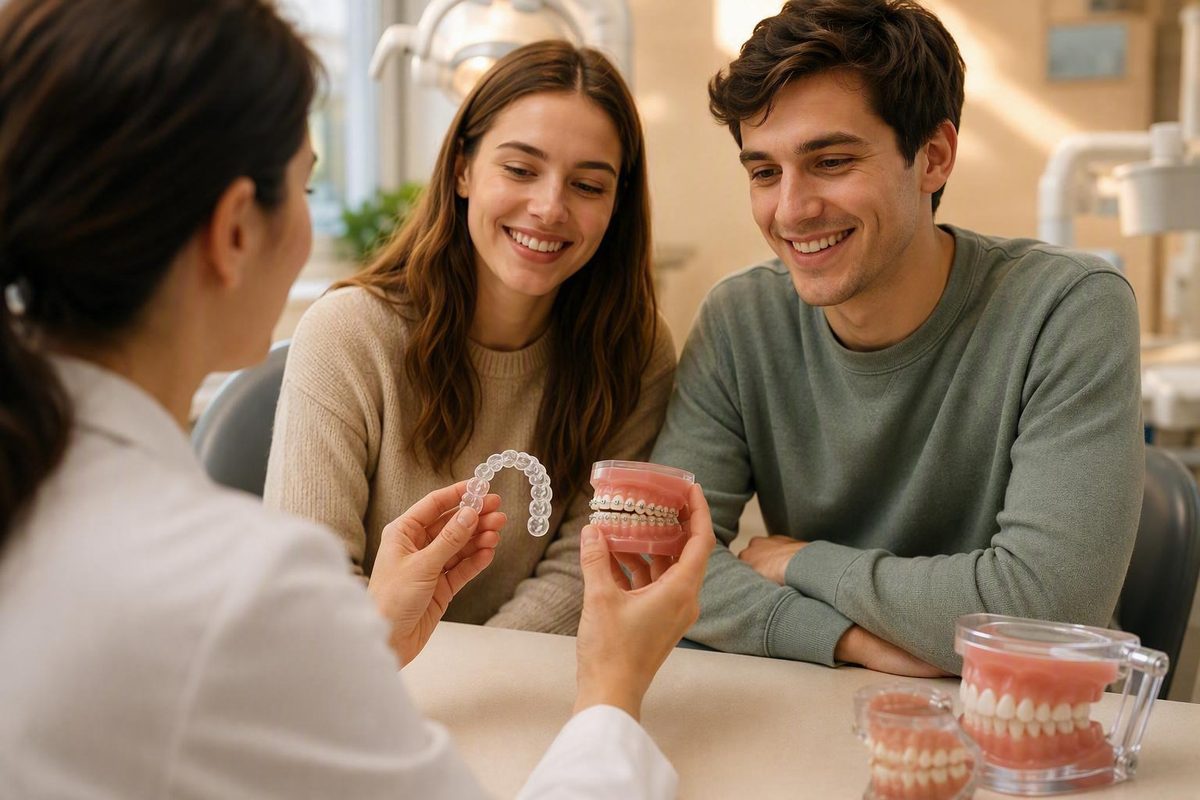
How to choose the right orthodontic appliance for your teeth and routine.
Invisalign vs. Braces at a Glance
There is no universal winner in the Invisalign versus braces comparison. The better option is the appliance that can perform the movements required by your diagnosis—and that you can manage consistently throughout treatment.
Invisalign uses a sequence of customized, removable clear aligners to move teeth gradually. Traditional braces use brackets bonded to the teeth and connected by archwires that are adjusted during treatment. This basic difference affects appearance, meals, cleaning, appliance care, and how much treatment depends on remembering to wear a removable device.
| Factor | Invisalign | Fixed braces |
|---|---|---|
| Removability | Removed for meals, most drinks, brushing, and flossing | Remain attached during active treatment |
| Visibility | Discreet, although attachments, elastics, and tray edges may be noticeable | Metal braces are visible; ceramic braces are less conspicuous |
| Wear requirement | Must be worn for the prescribed daily period | Patients do not need to remember to reinsert the appliance |
| Eating | Few appliance-related food restrictions while trays are removed | Foods likely to damage brackets or wires must be avoided |
| Oral hygiene | Teeth can be brushed and flossed after removing the trays | Cleaning requires extra attention around brackets and wires |
| Treatment scope | Suitable for many cases, depending on the required movements and treatment design | Commonly recommended by providers for selected difficult or complex movements |
| Appliance care | Trays must be stored, cleaned, and changed as instructed | Brackets and wires must be protected and breakages reported |
| Cost certainty | Depends on complexity, refinements, replacements, and included services | Depends on appliance type, complexity, repairs, duration, and included services |
Invisalign is better described as discreet, not invisible. Clear trays may be hard to notice at conversational distance, but tooth-colored attachments, elastics, and other treatment components can make them more apparent.
Removability is both Invisalign’s main convenience and its principal behavioral demand. Manufacturer guidance typically calls for 20–22 hours of daily wear, with the trays removed for meals and drinks other than water. Braces avoid the need to remember trays, but they still require cooperation with cleaning, food precautions, appliance care, elastics when prescribed, and scheduled visits. The manufacturer summarizes these basic distinctions on its Invisalign and braces comparison page.
A useful decision sequence is:
- Diagnosis establishes what needs to change.
- Treatment planning determines how those changes might be achieved.
- Your routine determines whether the plan is manageable.
- The complete fee determines whether it is affordable.
An online comparison can help you identify priorities. It cannot establish whether Invisalign or braces is appropriate for your teeth. That decision requires an individual assessment and treatment plan.
How Invisalign and Fixed Braces Move Teeth
Invisalign divides the intended correction into a sequence of custom trays. Each aligner is designed for a particular stage of treatment. After wearing one set for the prescribed period, the patient moves to the next set if the teeth are following the plan closely enough.
Fixed braces deliver force differently. Brackets are bonded to individual teeth and connected by an archwire. The orthodontist adjusts or replaces components as treatment progresses. Because the appliance remains attached, force delivery does not depend on the patient remembering to reinsert it.
The choice is therefore not merely cosmetic. Orthodontic treatment may need to address different kinds of movement, including:
- Rotating a tooth.
- Tipping its visible crown.
- Changing its root position.
- Raising or lowering it relative to neighboring teeth.
- Moving it through an available space.
- Coordinating the upper and lower arches.
- Changing how the teeth meet.
Two patients who both describe their problem as “crowding” may need very different plans. One may require limited alignment of the front teeth. Another may need space management, bite correction, or movements that the treating orthodontist considers more predictable with fixed mechanics.
Aligner treatment may use additional tools:
- Attachments: small, tooth-colored composite shapes bonded to selected teeth.
- Elastics: removable bands prescribed for particular treatment goals.
- Refinements: additional aligners ordered after progress is reassessed.
- Temporary brackets: a limited number of brackets used during part of an otherwise aligner-based plan.
Not every patient needs every auxiliary. Their use depends on the diagnosis and treatment design. Orthodontist Ryan McComb reports that most aligner cases in his practice use attachments and that his team sometimes combines aligners with a few temporary brackets. He also reports favoring brackets for heavy root movement and extraction-space closure. These are explicitly provider experiences—not controlled comparative findings or universal rules—but they illustrate why appliance recommendations can differ by movement and clinician technique. His practice-based comparison of Invisalign and braces explains that approach.
Professional assessment and monitoring matter because tooth alignment is only one part of orthodontic planning. In-person examination and appropriate records may identify concerns involving roots, supporting bone, gums, bite, or jaw relationships that are not apparent from photographs alone. Educational guidance on professionally supervised orthodontic treatment also warns against treating tooth movement as a purely cosmetic process.
That distinction is relevant when comparing professionally managed Invisalign with remote treatment that lacks adequate assessment or continuing oversight. During supervised treatment, the clinician can evaluate whether trays are fitting, appliances are intact, and actual progress remains consistent with the treatment plan.
Which Problems May Favor Invisalign or Braces?
Eligibility is more nuanced than dividing every case into “mild,” “moderate,” or “severe.” A case that looks modest may contain one demanding movement. A visibly crowded case may become aligner-compatible with suitable planning and auxiliaries.
The following matrix is practice-based orientation, not an evidence-ranked treatment guide or diagnosis. Movement-specific preferences largely come from provider experience and may differ among clinicians.
| Concern or movement | How aligners may fit | Why a provider might recommend braces |
|---|---|---|
| Selected crowding | Frequently considered when the required movements and space plan are aligner-compatible | Providers may prefer fixed control when crowding or the movement sequence is more demanding |
| Spacing | Often considered when tooth and root positions can be managed with an aligner plan | Fixed mechanics may be recommended where space management requires more direct control |
| Relapse after earlier treatment | May be practical for selected teeth that have shifted | Braces may be considered if the relapse includes more involved bite or tooth-position changes |
| Major rotations | May be planned with attachments, staging, and possible refinements | Some providers prefer brackets for more direct rotational control |
| Heavy root movement | May be included in selected aligner plans | One experienced provider reports preferring brackets for this movement |
| Vertical movement | Selected movements may be planned with attachments or other mechanics | Practice guidance commonly identifies difficult tooth-height changes as a reason to consider braces |
| Extraction-space closure | Possible in selected treatment plans | One experienced provider reports favoring brackets for this stage |
| Complex bite correction | Some dental bite concerns may be treated with aligners and elastics | Providers may recommend fixed mechanics when several difficult movements must be coordinated |
| Jaw-related discrepancy | May change tooth positions within the limits of the treatment plan | Braces likewise should not be assumed to resolve every problem arising primarily from jaw relationships |
Orthodontic practice guidance commonly presents aligners as an option for selected crowding, spacing, relapse, and bite cases, while describing braces as more versatile for severe crowding, major rotations, vertical movement, or complicated bite correction. These are clinical generalizations rather than universal boundaries, as reflected in this practice comparison of treatment scope.
Bite labels can also conceal important differences. “Overbite,” “underbite,” “crossbite,” and “open bite” describe relationships, not a single diagnosis. Ask the orthodontist whether the concern primarily involves tooth position, jaw relationship, or a combination—and what the proposed appliance can realistically change.
Hybrid treatment can make the choice less binary. An orthodontist may use aligners for most of treatment and temporarily place several brackets for a targeted movement. This can preserve some benefits of removable treatment without requiring trays to handle every stage. It may also affect the sequence, appearance, or fee, so the reason for the hybrid approach should be clear before treatment starts.
The most useful consultation question is not simply, “Can Invisalign treat my case?” Ask:
Which exact movements make the recommended appliance more predictable for my treatment plan?
Then ask what would happen if those movements did not occur as planned. The answer may involve attachments, elastics, refinements, temporary braces, a revised treatment goal, or another strategy.
Daily Life: Wear Time, Meals, Cleaning, Sports, and Visibility
The easier appliance is the one whose burdens fit your actual routine—not the routine you hope to adopt after treatment begins.
Aligner wear and meals
Invisalign is typically prescribed for 20–22 hours of daily wear. The trays are removed for meals and for drinks other than water, then reinserted without sacrificing the prescribed wear period. This schedule is described in an orthodontic practice overview of aligner wear and braces care.
The daily cycle is repetitive:
- Remove the trays.
- Store them securely rather than wrapping them in a napkin.
- Eat or drink.
- Clean your teeth as instructed.
- Rinse or clean the trays according to your provider’s directions.
- Reinsert them promptly.
- Repeat without losing too much wear time.
This may be manageable for someone who eats defined meals and has regular access to a washroom. It may be harder for a frequent snacker, someone who drinks coffee over several hours, or a traveler moving between meetings and flights.
When aligners are worn less than prescribed, the teeth may stop following the planned sequence.
Braces eliminate the remove-store-clean-reinsert cycle. They do, however, require food precautions. Hard, sticky, or crunchy foods may damage brackets or wires. Some foods may also need to be cut into smaller pieces rather than bitten directly.
Brushing and flossing
Aligners allow brushing and flossing without an appliance covering the teeth. That access is convenient, but hygiene still depends on consistent cleaning of both the teeth and trays.
Braces require careful cleaning around brackets, wires, and the gumline. Plaque can accumulate where cleaning is inadequate and may contribute to staining or decay, although those outcomes are not inevitable.
If your current brushing routine is inconsistent, ask the orthodontic team to demonstrate the care required for each appliance before you choose.
Visibility
Clear aligners are generally less conspicuous than metal braces, but they may still be noticed because of:
- Reflections from the tray surface.
- Plastic edges near the gumline.
- Tooth-colored attachments.
- Elastics.
- Temporary brackets.
- The act of removing or reinserting the trays.
Metal braces are more visible. Ceramic brackets use tooth-colored or translucent materials to reduce contrast, although they remain noticeable and can have different care or cost considerations.
Sports and active routines
Practice guidance indicates that aligners can be removed for contact sports, while patients with fixed braces may be advised to use a suitable protective mouthguard. The appropriate protection depends on the sport, appliance, fit, and treatment stage, so ask the treating orthodontist what to use rather than assuming the aligner itself provides sports protection.
Which routine sounds like yours?
The frequent snacker: Aligners preserve food choice while removed, but every snack creates another removal and reinsertion cycle. Braces avoid that cycle but require avoiding foods likely to damage the appliance.
The traveler: Aligners require secure storage and a plan for managing trays away from home. Braces cannot be misplaced, but a broken component may be inconvenient when you are away from the treating office.
The athlete: Removable trays may simplify participation if prescribed wear is still maintained. Fixed braces may require orthodontist-recommended protection.
The appearance-conscious professional: Aligners may be attractive if the planned movements are compatible and tray discipline is realistic. Ceramic or lingual braces may be alternatives when fixed treatment is recommended.
The person likely to lose or under-wear trays: A fixed appliance may provide more reliable force delivery. It is not maintenance-free; the burden shifts toward hygiene, dietary precautions, appliance protection, and attendance.
Comfort, Soreness, Breakages, and Other Treatment Burdens
Both Invisalign and braces can cause pressure, soreness, or discomfort as teeth move. The type of irritation differs, and individual experience varies.
Because aligners do not have fixed archwires or external bracket surfaces, they may avoid some of the cheek irritation associated with braces. That does not mean Invisalign is always more comfortable. New trays can feel tight, edges may rub, and attachments may feel prominent when the trays are removed.
Common aligner burdens include:
- Tightness when beginning a new tray.
- Repeated removal and reinsertion.
- Cleaning trays away from home.
- Lost, cracked, or distorted trays.
- Irritation from a tray edge.
- A tray that no longer seats closely.
- Additional assessment or refinements when progress differs from the plan.
- Remembering a storage case and supplies.
Common brace-related burdens include:
- Soreness after placement or adjustments.
- Irritation where brackets or wires contact the lips or cheeks.
- Loose brackets.
- Shifted or poking wires.
- Food collecting around the appliance.
- Additional cleaning time.
- Food precautions throughout treatment.
The correct response depends on the stage of treatment and the function of the affected component. Ask the treating office for instructions rather than independently advancing trays or making substantial appliance changes.
Braces are sometimes described as requiring no compliance because they cannot be removed. That is misleading. Fixed appliances still require patients to:
- Clean the teeth and appliance carefully.
- Avoid damaging foods and habits.
- Attend monitoring and adjustment visits.
- Wear elastics if prescribed.
- Report breakages.
- Follow the provider’s instructions for sports and appliance problems.
Before selecting a provider, ask how the office handles common interruptions:
- What should I do if an aligner is lost?
- What should I do if the current tray no longer fits?
- How quickly can a loose bracket or uncomfortable wire be assessed?
- Is guidance available outside normal office hours?
- Are replacement trays, repairs, and urgent visits included in the fee?
- Can repeated losses or breakages extend treatment or create added charges?
These questions clarify both the practical support available and the possible financial consequences of appliance problems.
Treatment Time and Appointment Frequency
Invisalign is not automatically faster than braces. Duration depends on the diagnosis, treatment goals, number and difficulty of the movements, biological response, appointment attendance, aligner wear, appliance breakages, and whether additional aligners are needed.
Consumer-facing provider estimates commonly place Invisalign at approximately 12–18 months and braces at 18–24 months or longer, but these are broad practice estimates rather than guarantees. One provider timeline comparison gives those ranges while acknowledging the role of case complexity and adherence.
Those averages can be misleading. If simpler cases are selected for aligners while braces are used for more demanding bite corrections or space management, aligner cases may have a shorter average without proving that the appliance itself is inherently faster. A fair comparison requires the same diagnosis and finishing goals.
A 2024 retrospective study of patients aged 12–18 at one tertiary care center reported mean treatment durations of 18 months for Invisalign and 24 months for braces, with reported correction rates of 88% and 90%, respectively. The study was retrospective and single-center, its supplied report did not clearly state the sample size or follow-up duration, and treatment selection may have affected the results. It also contained inconsistent reporting about the statistical significance of relapse findings. The authors called for larger prospective research, according to the published study available through PubMed Central.
The study therefore does not prove that Invisalign is generally faster or equivalent for every treatment goal. Its adolescent population also should not be assumed to represent adults, younger children, surgical cases, or every type of malocclusion.
Provider guidance often describes aligner checks at roughly six to eight weeks and braces appointments across a broader interval of approximately four to ten weeks, but actual schedules are case- and provider-specific.
When comparing consultations, request two individualized estimates:
- The projected active-treatment time with Invisalign for your diagnosis and agreed goals.
- The projected active-treatment time with braces for the same diagnosis and goals.
Ask what assumptions support each estimate. An aligner estimate may assume consistent wear and a particular refinement strategy. A braces estimate may assume reliable attendance and limited breakage. Also clarify what “finished” means: straighter front teeth alone, or the complete alignment and bite goals agreed at the start.
A useful estimate includes a range, the main sources of uncertainty, expected visit frequency, and the events most likely to cause delay.
Cost, Insurance, and the All-In Treatment Quote
Published provider sources disagree on whether Invisalign generally costs about the same as braces or more. Their quoted ranges overlap, and the final amount depends on the treatment plan, provider, location, duration, appliance type, refinements, and included services.
Invisalign’s manufacturer states that its treatment can cost about the same as braces, but this is a commercial claim and the supplied manufacturer page does not give a specific Invisalign price range. It cites an uninsured braces range of $3,000–$7,500, varying by provider, case complexity, age, and location. That figure is illustrative rather than a universal benchmark.
Do not compare headline prices without comparing what is included. One quote may include records, refinements, and retainers; another may cover only active appliance treatment.
Request an itemized quote covering:
- Initial examination and treatment planning.
- Photographs, scans, impressions, and other records.
- X-rays or other imaging.
- Placement or delivery of the appliance.
- Scheduled monitoring and adjustment visits.
- Attachments, elastics, or routine auxiliaries.
- Interproximal reduction if planned.
- Refinement scans and additional aligners.
- Replacement aligners.
- Repairs to brackets or wires.
- Urgent appointments.
- Removal of attachments or fixed appliances.
- The first set of retainers.
- Replacement retainers.
- Post-treatment checks and follow-up.
For aligner treatment, ask how many refinement rounds are included and whether an inclusion period applies. For braces, ask whether repairs are covered or whether repeated breakages incur charges. For either treatment, clarify whether adding temporary brackets, extending treatment, or changing the plan affects the fee.
Orthodontic insurance benefits are plan-specific. Do not assume Invisalign and braces receive identical coverage. Ask the insurer and provider to explain what the plan is expected to pay, when payments are issued, and what happens if coverage changes during treatment. Where possible, request the explanation in writing.
Payment plans may reduce the amount due at the beginning, but the monthly installment is not the total price. Compare:
- Deposit.
- Number and amount of payments.
- Interest or financing charges.
- Administrative fees.
- Total payable amount.
- Policy if treatment stops or you move.
- Financial consequences if treatment lasts longer than estimated.
The strongest comparison places Invisalign and braces side by side for the same diagnosis, treatment goals, provider services, retention plan, and likely contingencies. The relevant question is not only “What does treatment start at?” but “What am I likely to pay from assessment through retention?”
A Practical Decision Framework and Consultation Checklist
The decision should proceed in a deliberate sequence rather than beginning with appearance or advertising.
1. Establish oral-health readiness and the diagnosis
Ask whether any dental or gum concerns need attention before orthodontic treatment. Find out what examination, records, and imaging the clinician considers necessary.
Request the diagnosis in plain language. Does the concern involve crowding, spacing, rotation, tooth position, bite relationship, jaw relationship, or a combination?
2. Identify the required movements
Ask the orthodontist to show which teeth need to move and in what direction. Useful questions include:
- Which movements are expected to be straightforward?
- Which movements are difficult or uncertain?
- Is significant root movement involved?
- Does any tooth need substantial rotation or vertical movement?
- Will spaces be created or closed?
- Is the bite concern dental, jaw-related, or both?
These questions turn vague descriptions such as “simple” or “complex” into a more useful treatment discussion.
3. Compare predictability for the same goals
Do not compare an abbreviated aligner plan with comprehensive braces treatment. Confirm that both options are being judged against the same endpoint.
Ask:
- What result are we trying to achieve?
- Can both appliances pursue that full result?
- Why do you consider one more predictable?
- What compromise would come with my preferred option?
- What is the fallback if a planned movement does not occur?
4. Assess realistic compliance
Be honest about your behavior.
A disciplined adult with selected spacing may value aligners if the movements are suitable. Someone likely to lose trays, forget reinsertion, or resist wearing them most of the day may find a fixed appliance easier to manage. A patient with severe crowding or a movement the orthodontist considers difficult may be advised to consider braces even if aligner compliance would be excellent.
These are bounded examples, not automatic prescriptions. Age, responsibility, or appearance preference alone does not determine clinical suitability.
5. Compare daily burdens
Imagine an ordinary week rather than an ideal one. Include work or school, coffee, snacks, travel, sports, social events, access to brushing facilities, and willingness to manage appliance problems.
If visibility matters but fixed mechanics are recommended, ask about alternatives. Ceramic braces use less conspicuous brackets, while lingual braces sit behind the teeth and may involve higher cost, more difficult cleaning, initial tongue discomfort, and the need for specialist expertise. This overview of metal, ceramic, lingual, and clear-aligner options provides a broader comparison.
A hybrid plan may also use aligners for most stages and temporary brackets for a particular movement.
6. Review the complete fee and delay scenarios
Obtain an itemized total and ask how the cost could change if you:
- Need additional aligners.
- Lose or damage trays.
- Break brackets or wires.
- Miss visits.
- Extend treatment.
- Add temporary brackets.
- Switch appliances.
- Need replacement retainers.
Confirm what insurance is expected to pay, whether financing increases the total, and which services are excluded.
7. Confirm retention before treatment starts
Both Invisalign and braces are generally followed by retention. Retainers help maintain the result after active treatment; they do not continue straightening teeth in the same way as active appliances. Teeth may shift when retention instructions are not followed consistently, as explained in the educational guidance on braces, aligners, and retainers cited earlier.
Ask:
- Which type of retainer will I receive?
- When and how often should I wear it?
- Is the first set included?
- What do replacements cost?
- How will the fit be checked?
- What should I do if the retainer breaks, feels tight, or stops fitting?
Consultation checklist
Bring these questions to each orthodontic consultation:
- What is my complete diagnosis?
- Does the concern involve tooth position, jaw relationship, or both?
- Which exact tooth movements are required?
- Which movements favor aligners in your hands, and which favor braces?
- Would either option require a compromise in the final goal?
- Will I need attachments or elastics?
- Is interproximal reduction planned?
- Are extractions being considered, and why?
- Could a hybrid method help?
- How do you decide whether refinements are needed?
- What happens if an aligner stops fitting?
- What happens if I cannot maintain the prescribed wear?
- How often are scheduled visits for each option?
- Which events are most likely to delay treatment?
- What is the estimated timeline for the same goals with each appliance?
- What is included in the complete fee?
- What costs extra, including replacements, repairs, urgent visits, and retainers?
- How will progress and oral health be monitored?
- What retention plan follows active treatment?
- Why do you recommend this appliance for my diagnosis rather than simply for my age or appearance preference?
This article provides general information, not a diagnosis or personalized treatment recommendation. Treatment decisions should be made with an orthodontist, consistent with the site’s terms for orthodontic information.
Frequently Asked Questions
Can Invisalign fix an overbite or another bite problem?
Invisalign can be used for selected bite concerns, sometimes with attachments or elastics. Suitability depends on the cause of the discrepancy, the movements required, and the clinician’s treatment plan.
An overbite is not one uniform condition. It may involve tooth positions, jaw relationships, or both. Ask which part of the problem each proposed treatment can realistically change.
What happens if I do not wear Invisalign for 20–22 hours a day?
The manufacturer’s prescribed range is generally 20–22 hours per day. Wearing aligners less than directed may allow the teeth to fall behind the planned sequence, making the current or later trays difficult to seat.
There is no universal number of missed hours or days at which treatment fails. If an aligner stops fitting, contact the treating office rather than changing trays or altering the schedule independently.
Is Invisalign always faster than braces?
No. Provider estimates may show shorter average timelines for Invisalign, but case selection can affect those averages. Simpler cases may be assigned to aligners, while braces may be used for more demanding corrections.
The useful comparison is the projected timeline for your diagnosis and the same finishing goals. Wear consistency, refinements, difficult movements, breakages, and missed visits can all affect completion time.
Are Invisalign aligners completely invisible?
No. They are clear and usually less conspicuous than metal braces, but tray edges, reflections, attachments, and elastics may still be visible.
If appearance is a priority but fixed treatment is recommended, ask whether ceramic or lingual braces are appropriate alternatives.
Will I need a retainer after Invisalign or braces?
Generally, both treatments are followed by retention. Retainers help hold teeth in their corrected positions after active movement.
The appropriate retainer and wear schedule vary by patient and treatment plan. Confirm the type, included cost, replacement fee, and follow-up arrangements before treatment begins.
The practical conclusion is not that Invisalign or braces wins for everyone. Invisalign may suit a patient whose required movements are aligner-compatible and who can maintain the prescribed wear and tray-management routine. Fixed braces may offer useful control for selected complex movements and remove the need to remember trays, while introducing greater food, cleaning, and appliance-care demands.
Compare both options for the same treatment goals, request an itemized total fee, and ask the orthodontist to explain exactly why the recommended appliance is considered more predictable for your diagnosis.