
Is Invisalign Faster Than Braces? Sometimes
Straightforward cases may favor aligners; difficult tooth movements or substantial bite correction can make braces faster or more predictable.
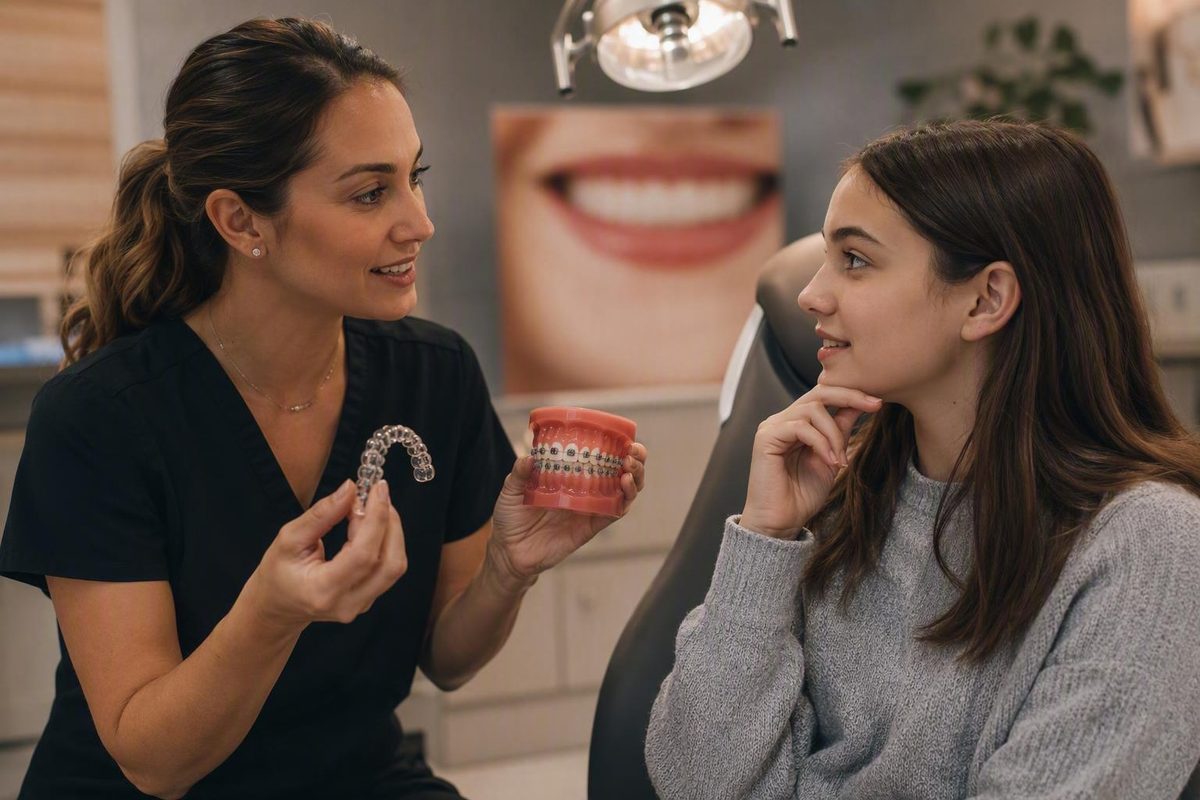
Invisalign may be faster for a suitable, straightforward case, but braces may be faster or more predictable when treatment requires difficult tooth movements or substantial bite correction. The meaningful comparison is not a headline average: it is the estimated full treatment time for your diagnosis, required movements, and ability to follow the plan.
The short answer: neither option is always faster
The supplied orthodontic-practice articles do not identify a universal winner. The Orthodontists says braces are generally faster for closing gaps and aligning teeth. Dorfner Dental Studio says Invisalign and braces usually take similar amounts of time in comparable cases, with aligners potentially finishing sooner for some mild or moderate problems. Neither article supports its position with independent research comparing cases of equivalent complexity.
That qualification—comparable cases—is essential. If aligners are used mainly for minor spacing and braces are used for impacted teeth, extractions, or major bite correction, the aligner group will naturally appear to finish sooner. That does not establish that aligners would complete the same difficult corrections faster.
It helps to separate three questions:
- Speed: How long is the full course of active treatment expected to take?
- Suitability: Can the appliance accomplish the movements your case requires?
- Predictability: How confident is the orthodontist that those movements will proceed as planned?
A shorter initial estimate is not necessarily the faster route to completion if the appliance is less suitable for the case, treatment stops tracking, or the plan must change.
When Invisalign may be the quicker option
Some orthodontic providers associate a possible Invisalign advantage with limited, straightforward corrections. These are provider-reported observations, not conclusions from independent research controlling for diagnosis and case complexity.
| Clinical situation | Possible time advantage | Important limitation |
|---|---|---|
| Mild spacing | A limited aligner sequence may close small gaps efficiently | The amount and cause of the spacing affect the plan |
| Mild crowding | Relatively limited alignment may require fewer treatment stages | Space requirements and the movements involved can change the timeline |
| Minor relapse | Previously treated teeth may need a comparatively small correction | The full bite still needs assessment, not only the visibly crooked tooth |
These scenarios come from a commercial orthodontic-practice comparison that associates aligner speed advantages with mild crowding, minor spacing, and minor relapse. The same comparison emphasizes that complexity and adherence can reverse the apparent advantage. Hulme Orthodontics presents these as conditional, case-dependent tendencies.
Any possible time advantage depends on two conditions. First, the case must be appropriate for Invisalign. Second, the patient must wear the aligners and change them according to the prescribed schedule. A straightforward plan can still take longer if the aligners are not worn consistently or the planned movements do not proceed as expected.
Digital planning, coordinated movement, easier cleaning, and the absence of brackets may make aligner treatment more convenient for some people. Those benefits do not, by themselves, demonstrate that Invisalign moves teeth faster than braces.
When braces may be faster or more predictable
Commercial provider articles describe braces as potentially more efficient or predictable when the treatment plan involves difficult movements. This is not proof that braces are universally faster, and it does not mean aligners are automatically unsuitable for every complex case.
| Clinical situation | Provider-reported braces advantage | Important limitation |
|---|---|---|
| Severe crowding | Direct fixed-appliance control during major alignment | Severity alone does not determine the appliance |
| Substantial bite correction | Greater predictability for some coordinated movements | Some bite problems may still be treated with aligners |
| Difficult rotations | Brackets may provide more reliable rotational control | Suitability depends on the tooth and complete plan |
| Vertical tooth movement | Fixed mechanics may offer greater control | Different vertical movements may require different approaches |
| Impacted teeth | Braces may fit more readily into a complex treatment plan | The complete treatment requirements must be assessed |
| Extraction-based plans | Fixed appliances may provide more predictable space control | Extraction treatment does not automatically exclude aligners |
| Unreliable aligner wear | Treatment does not depend on reinserting trays each day | Braces still require care and appointment attendance |
Dorfner Dental Studio reports that braces may be more efficient for severe bite problems, major tooth movement, rotation, or patients unlikely to follow an aligner-wear schedule. Hulme Orthodontics also identifies vertical movement, impacted teeth, extractions, and substantial rotations as situations in which fixed appliances may provide more predictable control. These are provider descriptions rather than findings from matched comparative research.
Braces remain attached to the teeth, eliminating the need to remember to reinsert an appliance after eating or brushing. That can make the practical timeline more dependable for someone who expects difficulty following a daily aligner schedule.
This does not mean Invisalign can never be used in complex treatment. Suitability depends on the diagnosis, required movements, treatment plan, clinician experience, and patient circumstances. One orthodontic-practice article also says that some aligner cases may need braces to finalize tooth positions, which can change the original timeline. That possibility should be discussed before treatment begins rather than assumed to be included in the first estimate.
Why aligner wear can erase a speed advantage
Invisalign is removable and applies its planned force only while the trays are being worn. Multiple commercial provider pages tell patients to wear aligners for approximately 20–22 hours per day. The McLean Orthodontist also warns that inadequate wear and missed checkups can prolong or disrupt treatment. These instructions are provider guidance; the supplied evidence does not include independent or manufacturer documentation for the wear figure. The McLean Orthodontist describes the 20–22-hour schedule and adherence-related delays.
If trays are removed too often, the teeth may not reach the position expected before the next scheduled aligner. Exactly how a tracking problem is handled depends on the case and provider.
Extra wear is not a shortcut. Keeping aligners in consistently for the prescribed time helps prevent avoidable delays, but it does not safely move teeth beyond the movements designed into the sequence. Patients should not change trays early, alter the schedule, or attempt to increase force without instructions from the treating orthodontist.
Fixed braces remove this particular patient-controlled variable because they remain attached. They are not delay-proof, however. Broken components and missed or postponed appointments can also interrupt planned progress.
Delays that can affect either timeline
Provider articles identify different ways that each appliance can fall behind schedule. The items below are possible delay factors, not predictions of how long any delay will last.
| Aligner-related delays | Braces-related delays |
|---|---|
| Wearing trays for less time than prescribed | Broken brackets, wires, or other components |
| Changing trays later than scheduled | Missed adjustment visits |
| Missing monitoring appointments | Postponed repairs |
| Teeth not moving according to the planned sequence | Unplanned changes to treatment mechanics |
| A change in the treatment plan | A change in the treatment plan |
| Oral-health problems that interrupt progress | Oral-health problems that interrupt progress |
Dorfner Dental Studio notes that braces can be disrupted by broken brackets or wires, while aligner progress depends on following the prescribed wear schedule. Other provider pages identify missed appointments and delayed repairs as possible sources of delay. These practical delay factors do not establish that either appliance is inherently faster.
Beyond appliance-specific problems, duration can be affected by:
- Case complexity
- The types and extent of tooth movement required
- Oral health
- Treatment planning
- Adherence to instructions
- Appointment attendance
- Individual response to tooth movement
Appointment frequency is not the same as total treatment duration. Invisalign monitoring visits may be scheduled differently from braces adjustments, but fewer or more widely spaced visits do not prove that the teeth will reach their planned positions sooner. Speed should be measured across the entire active course, not by the number of office visits.
How to interpret the treatment-time numbers online
Published treatment ranges vary substantially among commercial dental and orthodontic practices. They should not be treated as research-backed averages, guaranteed durations, or personal forecasts.
For example, The McLean Orthodontist publishes an estimate of 6–18 months for Invisalign and 18–24 months for braces, while acknowledging that complex cases may take similar amounts of time with either appliance. The page does not cite comparative research supporting those figures. The practice presents both ranges as general estimates affected by complexity and compliance.
Other commercial estimates differ. Hulme Orthodontics publishes selected tables ranging from 6–12 months for Invisalign in mild cases to 24–36 months for braces in severe or complex cases, while McCarty Orthodontics gives 12–18 months for Invisalign and 18 months to three years for braces. These pages likewise do not provide independent evidence establishing the figures as universal averages. McCarty Orthodontics attributes its broad ranges to factors such as complexity and compliance.
These estimates may describe very different patient groups. A short aligner plan for minor relapse cannot be meaningfully compared with a multi-year braces plan involving major bite correction or difficult tooth movement. The difference may primarily reflect diagnosis and case selection rather than the intrinsic speed of the appliance.
When reviewing a quote, ask what “treatment time” includes. Confirm whether the estimate accounts for:
- Additional aligners
- New scans or records
- Monitoring or manufacturing intervals
- Pauses caused by oral-health problems
- Treatment-plan changes
- A possible finishing phase with braces
Do not assume any of these items are included unless the provider says so in the written plan. The most useful comparison is a pair of estimates prepared for the same diagnosis, treatment goals, and required movements.
Questions to ask before choosing the supposedly faster option
Bring this checklist to your orthodontic consultation:
- What is my complete orthodontic diagnosis?
- Which teeth need to move, and what kinds of movement are required?
- Are both braces and Invisalign clinically suitable for my case?
- What is the expected full active-treatment duration with each suitable option?
- Are those estimates based on patients with problems similar in complexity to mine?
- Does the Invisalign estimate cover only the first aligner series or the anticipated complete course?
- Does the estimate include possible additional aligners, new scans, and treatment-plan changes?
- Is there a meaningful possibility that I would need braces to finish an aligner case?
- How would missed visits, late tray changes, broken components, or postponed repairs affect the plan?
- Which parts of the timeline depend on my daily compliance?
- Which potential delays, including scheduling or manufacturing, are within the provider’s control?
- Is the faster-looking option also the more predictable option for my required movements?
- What assumptions were used to calculate the proposed completion date?
- If treatment runs longer than estimated, could that change the cost?
Speed is only one decision factor. Compare it with effectiveness, predictability, appearance, hygiene demands, comfort, cost, appointment burden, and fit with your routine. Someone who values removability but cannot reliably follow the wear schedule may find fixed braces more practical. Someone with a suitable limited correction and consistent habits may prefer Invisalign.
Ask the orthodontist to put both clinically suitable options on the same footing: the same treatment goals, the complete anticipated active course, and the same assumptions about attendance and adherence. This article provides general information rather than treatment advice.
Frequently asked questions
Can wearing Invisalign longer than 22 hours a day make treatment faster?
Not beyond the schedule designed by your orthodontist. Consistent prescribed wear can help prevent delays, but extra wear does not make teeth safely advance beyond the movement planned for each aligner. Do not change trays early or modify the schedule without instructions from the treating provider. Hulme Orthodontics specifically states that wear beyond the prescribed 20–22 hours does not accelerate movement beyond the treatment design.
Can an Invisalign case still need braces before treatment is complete?
Yes. A commercial orthodontic-practice article says some aligner cases may need braces to finalize tooth positions. This is a possibility, not an inevitable part of Invisalign treatment. Ask before starting whether the proposed timeline and price account for a change in appliance if particular movements do not proceed as planned.