
Do Clear Aligners Release Microplastics? 2026 Evidence
Laboratory studies show aligners can shed micro- and nanoplastics, but patient dose and health effects remain unknown. See what researchers measured.
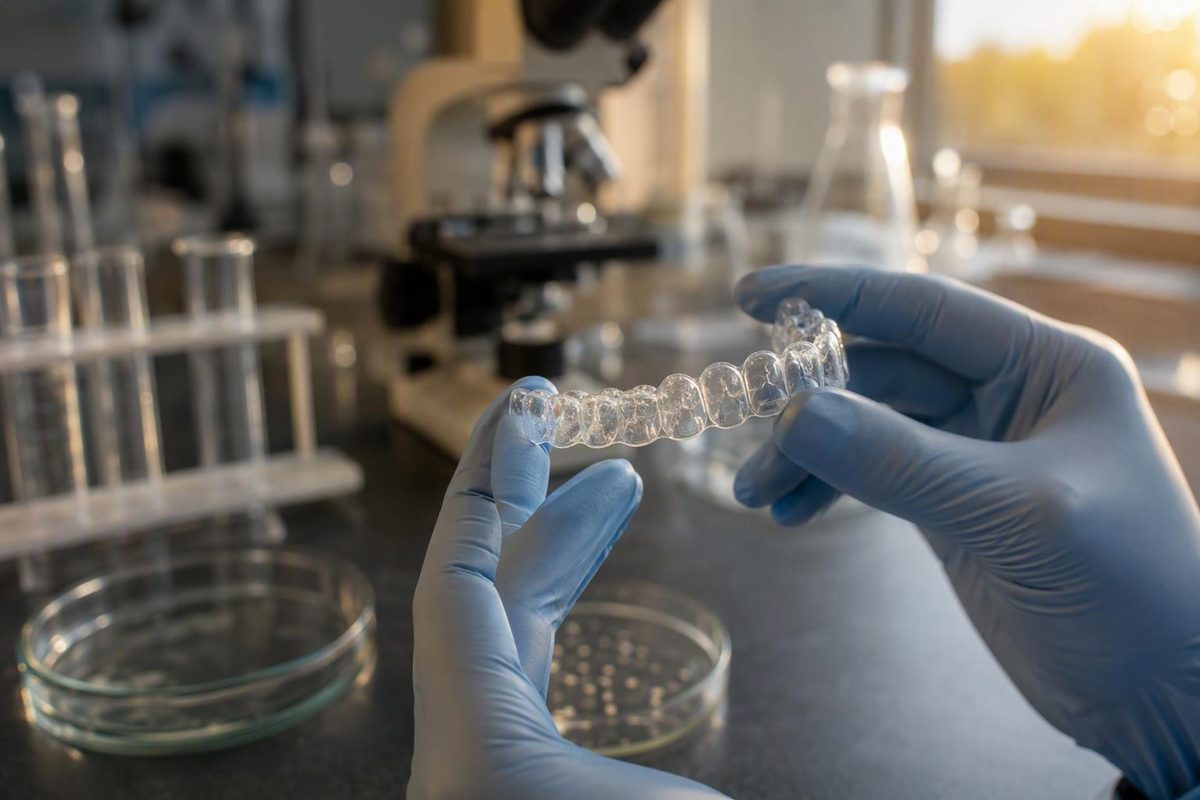
Yes. Clear aligners have released measurable microplastic—and, in some experiments, nanoplastic—particles under laboratory and simulated-wear conditions. What remains unknown is how many particles patients encounter, swallow, absorb, or retain during treatment. No current evidence shows that aligner-derived particles cause clinically meaningful harm or disease in patients.
Filter the evidence by study setting, then sort it to see exactly what each source measured.
Every particle-release experiment listed here was conducted in a laboratory. No included source measured a typical patient’s swallowed or absorbed dose.
Showing 6 sources: 3 laboratory experiments, 3 reviews or syntheses, and 0 in-patient exposure studies.
| Source | Year | Setting | Devices or Material | Simulated Wear Time | Particle Size Reported | What Was Measured | What It Cannot Establish |
|---|---|---|---|---|---|---|---|
| Six-device release and macrophage experiment | 2026 | Laboratory | Six devices: three thermoformed materials and three directly printed polymers; aligners, retainers, and sleep appliances included | One week with daily vortex mixing in artificial saliva | Micro- and nanoplastic fragments | Particle release using flow cytometry and electron microscopy; uptake and altered responses in macrophages | Patient release rate, swallowed or absorbed dose, tissue accumulation, or disease |
| 10-system simulated-friction experiment summarized by the editorial | — | Laboratory | 10 commercial aligner systems with differing compositions and manufacturing methods | 7 or 14 days in artificial saliva | Particles smaller than 5 µm became more evident after 14 days | Particle counts and size patterns after mechanical friction; release increased with test duration | Normal oral exposure, swallowed mass, or whether 7-day wear is safer than 14-day wear |
| Cyclic-loading experiment summarized by the editorial | — | Laboratory | Aligner materials exposed to repeated mechanical loading | — | — | Surface damage, cracks or chips, and detached material | How the loading protocol compares with an individual patient’s bite or total exposure |
| Clear-aligner microplastics scoping review | 2026 | Review | 638 records found; 250 duplicates removed; 388 titles and abstracts screened; 10 full texts assessed; six articles included | Not an appliance test | Varied across included literature | Presence and characteristics of available research through February 2025 | An independent patient-dose estimate, pooled effect size, or clinical-risk calculation |
| Korean Journal of Orthodontics editorial | 2026 | Editorial | Experimental shedding studies, leaching research, and regulatory context | Not an appliance test | Varied across cited studies | Narrative comparison of findings, disagreements, and research gaps | New experimental data or a systematic clinical-risk estimate |
| Systematic review of released chemicals and biological compatibility | 2025 | Review | Clear-aligner materials examined for chemical release, cytotoxicity, and oral effects | Varied across included studies | Not a physical-particle review | Leachables, cytotoxicity, and biological-compatibility findings | Whether microplastic fragments detach during wear |
Reading the gap: Laboratory rows establish that release can occur. Review rows map or interpret existing research. The in-patient filter has no rows because the cited evidence provides no dependable patient-level particle dose.
Sources: 2026 University at Buffalo study report and underlying Progress in Orthodontics paper; 2026 scoping review; 2026 Korean Journal of Orthodontics editorial; 2025 systematic review. — means the supplied evidence did not report the value.
A 2026 scoping review reached the same calibrated verdict: available evidence indicates particle release, but the magnitude of any human-health risk remains uncertain. The evidence base was small, heterogeneous, and largely laboratory-based rather than drawn from long-term patient research in its map of clear-aligner microplastic studies.
Detecting particles establishes that release can occur under particular test conditions. It does not establish a patient’s daily exposure, absorbed dose, cumulative treatment exposure, or risk of disease.
The American Association of Orthodontists says it has no formal position on microplastics in clear aligners and considers the evidence insufficient for definitive conclusions. It has convened researchers to review the literature and asked its foundation to seek additional research proposals through its clear-aligner microplastics initiative.
Particle Shedding Is Not the Same as Chemical Leaching
The phrase “plastic release” can describe several distinct findings.
Microplastics are physical pieces or fragments of plastic. A commonly used upper boundary is less than 5 millimeters, covering an enormous size range. Nanoplastics are smaller and may require different collection and analytical methods. Definitions are not completely consistent across publications, so the reported size range and detection limit matter more than the label alone as the University at Buffalo’s study account explains.
The 2026 scoping review, for example, reproduces a definition of microplastics as particles smaller than 5 micrometers—far narrower than the commonly used 5-millimeter boundary. Two papers using the word microplastic may therefore be discussing very different particle sizes.
Particle shedding also differs from chemical leaching:
- Particle shedding means physical fragments detach from an appliance.
- Chemical leaching means individual chemicals migrate out of its material.
- Resin-residue release concerns residual or incompletely reacted components.
- BPA testing asks specifically whether bisphenol A is present or released.
- Cytotoxicity testing examines how a material or extract affects cells under defined conditions.
A BPA-free polymer can still undergo abrasion or microscopic fragmentation. Conversely, finding particles does not establish that they contain BPA or another harmful chemical.
A 2025 systematic review evaluated chemical release, cytotoxicity, and oral effects associated with clear-aligner materials. It informs questions about leachables and biological compatibility, but it does not establish whether physical particles detach during wear in its review of chemicals released from aligners.
The Evidence Is Strongest for Release in Laboratory Tests
The evidence can be separated into five stages:
- Particles detach from an appliance under a defined test.
- Patients encounter those particles during ordinary wear.
- Some amount is swallowed, inhaled, absorbed, retained, or excreted.
- A realistic exposure produces a biological response.
- That response causes symptoms, impaired function, or disease.
Current support is strongest at the first stage. Laboratory cell research reaches into the fourth stage by testing whether collected particles interact with cells, but the patient-exposure steps between them remain largely unmeasured. Clinical harm has not been demonstrated.
The University at Buffalo–reported experiment tested six devices from different manufacturers: three thermoformed materials and three directly printed polymers. Researchers incubated them in artificial saliva, used daily vortex mixing for one week, and examined released material with flow cytometry and scanning and transmission electron microscopy.
Both manufacturing groups released measurable micro- and nanoplastic fragments. The directly printed materials released more particles in this experiment. Researchers also observed macrophages taking up released particles. The experiment did not measure how much material a patient swallows or absorbs, and it did not demonstrate disease.
Artificial saliva, incubation, vortexing, particle imaging, and cell exposure are useful for establishing whether release is possible. They do not reproduce changing saliva flow, eating and drinking, oral microbes, cleaning, tray removal, variable bite forces, swallowing, excretion, or an entire course of treatment.
Simulated Wear Links Mechanical Exposure to More Release
Research summarized by the Korean Journal of Orthodontics compared several forms of laboratory wear. In one experiment, control samples held in artificial saliva without friction had no detectable release, while particles appeared and increased under mechanical exposure. That supports a connection between the tested friction process and shedding—not a calculation of what a patient swallows.
The editorial also describes 10 commercial aligner systems subjected to simulated friction in artificial saliva for 7 or 14 days. Release increased with test duration, and particles smaller than 5 micrometers became more evident after 14 days. Separate cyclic-loading research reported cracks or chips alongside particle detachment in the journal’s synthesis of simulated-wear studies.
Static immersion, vortex mixing, friction rigs, and cyclic loading answer different questions. Each isolates selected parts of material aging, but none is equivalent to months of wear in a living mouth.
Test results can vary with polymer composition, multilayer construction, resin formulation, printing orientation, curing, polishing, trimming, tray thickness, initial surface roughness, test temperature, fluid composition, applied force, duration, collection filters, and instrument sensitivity. These differences make direct comparisons difficult.
The 7-day and 14-day results should not be converted into a recommendation to change trays sooner. They do not establish that a 7-day schedule is medically safer than a 14-day schedule. Replacement timing also depends on tooth movement, fit, treatment design, and clinical response.
Printed and Thermoformed Aligners Cannot Yet Be Ranked
Directly printed aligners are made from printable resins through additive manufacturing, followed by cleaning, curing, and finishing. Thermoformed aligners are shaped from polymer sheets. Neither category represents a single material or production process.
The six-device experiment found more particles from its three directly printed polymers than from its three thermoformed materials. That result applies to those devices and conditions; it does not prove that every printed aligner sheds more than every thermoformed one.
Research summarized in the journal editorial produced a different product-level pattern. Particle release varied with composition, but the broad distinction between thermoformed and directly printed products was not significantly correlated with particle count.
Both findings can be accurate. Printed products can differ in resin chemistry, layer characteristics, curing, polishing, and surface quality. Thermoformed products can differ in polymer type, multilayer design, thickness, heating, trimming, and initial surface condition.
A useful comparison would require standardized wear conditions, particle count and mass, size distribution, polymer identity, surface chemistry, manufacturing details, pre-test and post-test surface measurements, and independent replication.
The existing mixed-product results also cannot be assigned automatically to Invisalign or any other named brand. Without standardized brand-specific testing, manufacturing method alone is not a sound basis for claiming one category is universally safer.
Macrophage Uptake Shows Plausibility, Not Patient Harm
Macrophages are immune cells that take up foreign material and cellular debris. In the 2026 laboratory experiment, researchers captured live-cell images of macrophages ingesting aligner-derived micro- and nanoplastic particles and reported altered immune responses in those cells in the underlying study.
That finding establishes that released material can interact with immune cells under the experiment’s conditions. It provides a reason to study dose, uptake, persistence, and tissue effects more closely.
It does not show that aligner patients develop chronic inflammation, impaired infection control, delayed healing, or systemic immune dysfunction. Laboratory uptake also does not prove that particles cross a patient’s oral or intestinal barriers, enter tissue, remain there, or reach a clinically significant concentration.
Researchers still lack several links: the count and mass released during actual wear, the proportion swallowed, survival through digestion, uptake across biological barriers, distribution to tissues, persistence, and whether the cell concentration used in the laboratory resembles patient exposure.
Broader studies of microplastics from food, air, packaging, or industrial pollution cannot fill those gaps. Particle composition, size, shape, surface chemistry, dose, exposure route, and duration may differ substantially from aligner-derived exposure.
Patient Dose and Long-Term Effects Remain Unknown
The 2026 scoping review found 638 records, removed 250 duplicates, screened 388 titles and abstracts, assessed 10 full texts, and included six articles. Its search covered English-language material from the preceding 10 years through February 2025, included gray literature, and was conducted by one researcher.
Those methods produced a useful map of a small research field, not a clinical-risk estimate. A scoping review can show what researchers have studied and where evidence is missing, but it does not necessarily calculate an effect size or establish causation.
No available source provides a dependable estimate of the number or mass of aligner-derived particles a typical patient encounters each day or across treatment. The swallowed, absorbed, and retained amounts are also unknown.
Both particle count and total mass are necessary. A sample may contain many extremely small particles but less mass than one containing a few larger fragments. Count alone can obscure that difference; mass alone can conceal a substantial nanoplastic fraction.
Future patient research would need to report particle count, recovered mass, size distribution, shape, polymer identity, surface chemistry, nanoplastic proportion, appliance construction, wear duration, tray damage, cleaning protocol, collection method, contamination controls, and detection limits. It would also need to distinguish aligner particles from those originating in food, drinks, toothbrushes, storage cases, packaging, laboratory equipment, and the surrounding environment.
A “none detected” result means none were detected by that method under those conditions. Filters and instruments can miss particles below their detection range.
The supplied evidence contains no validated safe-exposure threshold specific to aligner-derived particles. Without a credible patient dose and relevant threshold, ordinary exposure cannot responsibly be classified as either harmless or hazardous.
Current Evidence Does Not Support Stopping Treatment
Patients should not stop wearing aligners, shorten wear time, change trays early, extend tray use, or switch appliance types solely because laboratory shedding has been documented. Treatment changes should be made with the treating orthodontist, who can assess movement, fit, treatment design, and clinical response.
Ask for an inspection if a tray becomes cracked, chipped, warped, unusually rough, or heavily scratched. Avoid hot water that could distort the appliance, and use the cleaning method recommended for that treatment system. These measures protect fit and avoid unnecessary damage; they have not been proven to reduce absorbed microplastic dose or prevent disease. More detailed care instructions are available for patients who need to clean and store the trays.
Switching automatically to fixed braces is not an evidence-based response. Braces and aligners differ in materials, maintenance, visibility, eating restrictions, hygiene demands, and treatment suitability. Particle release from aligners does not establish that fixed appliances are safer overall for every patient.
Retainers and sleep appliances were also included in the six-device laboratory experiment. That makes shedding relevant beyond active aligner treatment, but the study did not compare cumulative exposure among appliance types. A retainer’s longer period of use is a research question, not proof that it creates greater exposure.
The evidence supports realistic patient studies, transparent material reporting, improved nanoplastic detection, and independent product testing. It does not support panic, a guarantee of zero risk, or claims that laboratory particle detection proves disease.