
How to Clean Clear Retainers Safely: Daily & Deep Cleaning
Use a material-compatible cleaner only when deeper cleaning is needed.
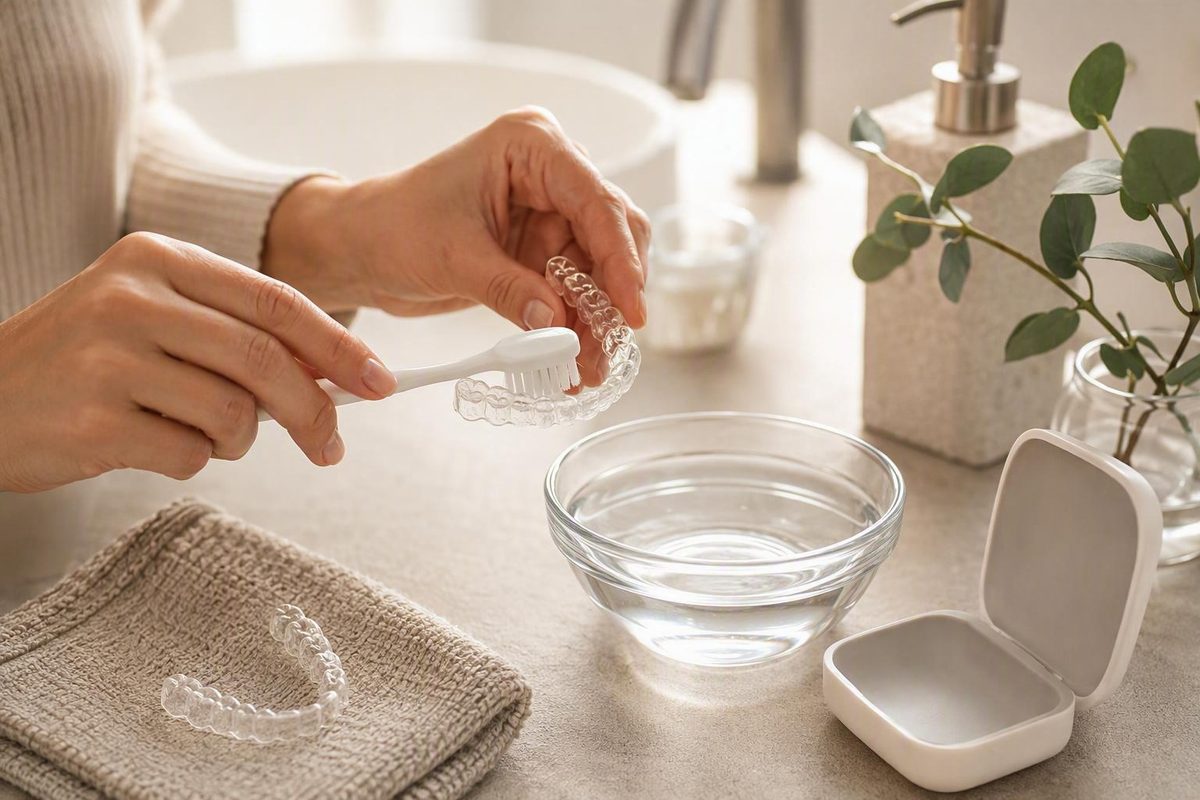
Use a material-compatible cleaner only when deeper cleaning is needed.
These instructions primarily apply to Essix- or aligner-style retainers made entirely from clear plastic. Active aligners, Hawley retainers containing acrylic and metal, and fixed bonded wires require somewhat different care. If you cannot identify your appliance or its material, ask your orthodontist before soaking it in anything.
The safest clear-retainer cleaning routine at a glance
Daily cleaning and occasional deep cleaning serve different purposes. Gentle brushing removes saliva, debris, plaque, and surface film. A compatible soak may loosen more persistent residue, but it supplements rather than replaces mechanical cleaning.
Daily routine
- Remove and promptly rinse the retainer under cool or lukewarm running water.
- Put a small amount of mild clear unscented dish soap or an appliance-approved cleaner on a separate soft-bristled toothbrush.
- Brush gently across the inside, outside, tooth-shaped depressions, grooves, ridges, and edges.
- Rinse thoroughly until no soap, cleaner, taste, or visible residue remains.
- Let excess water drain, then place the retainer in a clean protective case.
- Clean your teeth before reinserting the appliance, particularly after eating.
This routine follows the American Association of Orthodontists’ retainer-care guidance, which recommends lukewarm rinsing, daily cleaning with a dedicated toothbrush and dish soap, and avoiding toothpaste.
Occasional deeper clean
About once weekly is a useful general reference, not a universal prescription. Some orthodontic practices recommend deep cleaning two or three times per week, while others advise every week or two. Those are practice recommendations rather than a single established interval, so the appliance instructions and treating orthodontist’s advice take priority.
The conservative default is a cleaner specifically labeled for clear retainers:
- Confirm that the cleaner is compatible with the appliance.
- Use the amount of water and cleaner stated on the label.
- Soak for exactly the directed time.
- Brush gently afterward only if the instructions permit or require it.
- Rinse thoroughly and inspect the retainer under good light.
Never assume that doubling the concentration or soaking time will produce a better result. Products intended for clear plastic should be used for the labeled duration because excessive soaking may damage the appliance (Children’s Dental Center’s material-specific guidance).
Compact safety checklist
For a removable all-plastic clear retainer:
- Do: use cool or lukewarm water, a soft brush, mild clear unscented soap, and gentle pressure.
- Do: choose a cleaner specifically labeled for clear retainers when deeper cleaning is needed.
- Do: follow the cleaner’s dilution, temperature, and soak-time directions exactly.
- Do not: use toothpaste, hot or boiling water, a dishwasher, bleach, rubbing alcohol, or alcohol-based mouthwash.
- Do not: scrub aggressively, scrape deposits, or soak longer than directed.
- Do not: leave the appliance in direct sunlight, a hot vehicle, or near another strong heat source.
Step-by-step daily cleaning without scratching the plastic
Prompt, gentle cleaning matters more than force. Saliva and debris are easier to remove before they dry or harden in the appliance’s narrow tooth impressions. Rinsing immediately also reduces the temptation to scrub or scrape stubborn residue later.
1. Rinse as soon as practical
Hold the retainer under cool or lukewarm running water after removing it. Lukewarm water is acceptable for rinsing, but it should not be treated as a sanitizing method. Hot water is the hazard.
Rinse both sides and allow the water to reach the tooth-shaped depressions and edges. This removes loose saliva and debris before they dry.
2. Use a dedicated soft toothbrush
Keep a separate soft-bristled toothbrush for the retainer.
Replace the brush if its bristles become stiff or splayed. Use light, controlled strokes; hard bristles and forceful scrubbing can mar the surface of a clear retainer.
3. Add a small amount of suitable cleaner
Use a drop of mild, clear, unscented dish soap or a cleaner approved for the appliance. Clear, fragrance-free soap is the simplest default because strongly colored or scented products may leave an unwanted taste, fragrance, or pigment.
Do not assume that a product labeled “antibacterial,” “whitening,” or “extra strength” is suitable. Compatibility with oral-appliance plastic matters more than the cleaner’s marketing strength.
4. Brush every surface gently
Support the retainer in your hand without squeezing, bending, or repeatedly flexing it. Brush:
- The tooth-facing inner surfaces
- The smooth outer surfaces
- Every tooth-shaped depression
- Grooves and ridges
- The edge that follows the gumline
- Corners where visible film collects
Use short, gentle strokes. Orthodontic practice guidance specifically recommends concentrating on inner surfaces and using a soap-dampened cotton swab for tight grooves and ridges (Dr. Matt Orthodontics’ clear-retainer guide).
Do not use a pin, knife, fingernail, or other hard object to scrape the appliance. Scraping can gouge the plastic or alter an edge.
5. Rinse until no cleaner remains
Rinse every surface under cool or lukewarm water. Pay particular attention to deep tooth impressions where soap can remain trapped.
Examine the retainer under good light. It should have no visible suds or slippery residue. If it still tastes or smells strongly of soap, rinse it again.
6. Clean your teeth before reinsertion
Make retainer cleaning part of your daily oral-care routine. After eating, clean your teeth before replacing the retainer so food particles and sugary residue are not held beneath it.
Unless your orthodontist has instructed otherwise, remove a removable retainer for meals and for drinks other than water. If brushing is temporarily impractical, rinse your mouth and the appliance as an interim step, then clean both properly when possible.
Why soaking alone is not enough
A soaking solution may loosen film, odor-producing residue, or deposits, but it does not necessarily remove plaque attached to the appliance. Some practice guidance expressly notes that soaking agents do not remove plaque, which is why gentle brushing remains necessary (Children’s Dental Associates’ retainer-care overview).
Think of soaking as an occasional assist. The foundation is prompt rinsing followed by careful mechanical cleaning.
How to deep-clean a clear retainer safely
Deep cleaning should be a controlled maintenance step, not an attempt to sterilize the appliance. The supplied evidence does not establish that any home soak kills every microorganism, so do not describe or rely on routine home cleaning as sterilization.
Use this decision hierarchy:
- Follow the instructions supplied with the retainer or cleaner.
- If those instructions are missing or unclear, ask the treating orthodontist.
- Otherwise, choose a product explicitly labeled for clear retainers, confirm compatibility, and follow its directions exactly.
How often to deep-clean
There is no single interval for every retainer and wear schedule. One orthodontic practice recommends deeper cleaning two or three times per week (Tebo Orthodontics’ aligner and retainer guidance). Other guidance recommends every week or two, depending on the appliance, product, and clinician’s advice.
For that reason, about once weekly is a practical reference rather than a requirement. Someone who wears a retainer only at night may receive different instructions from someone wearing one for most of the day.
How to use a commercial retainer cleaner
Read the entire label before starting. Then:
- Confirm that the product is suitable for clear plastic retainers.
- Use the specified water temperature.
- Measure the water and cleaner as directed.
- Set a timer for the stated soaking duration.
- Remove the appliance promptly when the time expires.
- Brush gently afterward only if the label permits or instructs it.
- Rinse every surface thoroughly.
- Inspect the appliance for remaining film or deposits.
If residue remains after one compatible cleaning cycle, do not escalate to hard scrubbing or scraping. Ask a dental professional whether the appliance can be cleaned professionally or needs replacement.
Household soaks are conditional, not universal
Vinegar, hydrogen peroxide, and baking soda appear in dental-practice guidance, but recommended concentrations, durations, and material cautions differ. That disagreement is a reason not to present one homemade recipe as safe for every clear retainer.
- Vinegar: Acidic solutions may not suit every appliance. Vinegar should not automatically be used on a retainer containing metal because it may react with or damage metal components, according to Great Lakes Family Dental’s retainer guidance.
- Hydrogen peroxide: Some practices recommend diluted solutions, but the supplied guidance does not establish one concentration, duration, or frequency as universally compatible with every clear-retainer polymer.
- Baking soda: It appears in several practice guides, but it is mildly abrasive. Dry powder, a thick paste, or forceful brushing may scratch clear plastic.
- Denture cleaner or mouthwash: Guidance conflicts. Some practices permit limited use of particular products, while others warn that certain formulas may discolor, dry, weaken, or otherwise affect retainer materials.
These variations reflect practice advice rather than a universal standard. Material-specific instructions should govern; Complete Smiles likewise advises matching cleaning methods to the appliance and avoiding undiluted or abrasive preparations (its review of household retainer-cleaning methods).
If your orthodontist has approved a household method, follow that specific advice. If the material is unknown, do not experiment: use mild soap for routine cleaning and ask which deeper-cleaning product is compatible.
What not to use—and why
Many household products are designed for enamel, laundry, dishes, counters, or dentures—not thin, custom-formed retainer plastic.
Toothpaste
Do not use ordinary, whitening, charcoal, or other abrasive toothpaste as the default cleaner. Abrasive particles can create fine scratches, roughen or dull the surface, and make transparent plastic appear cloudy. Scratches and roughened areas may also collect discoloration or buildup more readily.
Even toothpaste marketed as gentle is unnecessary when mild clear unscented soap or an approved appliance cleaner is available.
Hot water and strong heat
Avoid:
- Hot or boiling water
- Dishwashers
- Microwaves
- Direct sunlight
- Hot vehicles
- Radiators, heaters, and other strong heat sources
Clear retainers are custom-shaped. Strong heat can warp the plastic and change the fit; Children’s Dental Associates warns that very hot water can cause a retainer to lose its custom shape (its orthodontic-retention guidance).
Use cool or lukewarm water for the retainer itself. Warm water may be used to wash an empty case, but the case should be rinsed and dried before the retainer is returned to it.
Harsh chemicals and inappropriate rinses
Do not use bleach, rubbing alcohol, alcohol-based mouthwash, harsh detergents, household disinfectant wipes, or surface-cleaning sprays as general-purpose retainer cleaners. Retainer-care guidance also warns against hot water, alcohol, bleach, harsh detergents, and colored or scented soaps because they may damage, weaken, discolor, or leave residue on the appliance (Image Orthodontics’ material-care guidance).
Some practices permit particular non-alcoholic mouthwashes or occasional denture-cleaning products, while others discourage them. Because formulas and retainer materials vary, neither is a sensible default without product-specific or professional approval.
Hard brushes, aggressive scrubbing, and scraping
Hard bristles and forceful scrubbing can roughen or scratch clear plastic. Scraping crusty deposits with a fingernail or tool can gouge the surface, create a sharp area, or alter the edge.
Likewise, a cleaner that is compatible for a short cycle may not be safe for prolonged soaking. Follow its stated time rather than assuming that longer contact is better.
Cleaning can remove residue, but it cannot reliably reverse:
- Deep scratches
- Permanent cloudiness caused by surface wear
- Material degradation
- A distorted shape
- A changed fit
When the problem is physical damage rather than dirt, stronger cleaning adds risk without repairing the appliance.
Clean the case and store the retainer safely
Case care is part of retainer care. A freshly cleaned appliance can pick up residue or odor again if it is returned to a dirty, damp case.
How to clean the case
On a regular schedule:
- Empty the case.
- Wash it with mild soap and warm—not hot—water.
- Use a soft brush or clean cloth around corners and ventilation openings.
- Rinse thoroughly.
- Leave the case open until fully dry.
Recommendations for frequency vary. Some orthodontic guidance advises daily case cleaning (Bay Bird Orthodontics’ retainer-care instructions), while other practice guidance recommends once or twice weekly. These are practical schedules rather than evidence that one interval is superior.
A reasonable approach is to wash the case whenever it is visibly soiled or develops an odor and to establish a regular routine you can maintain. Do not repeatedly apply stronger chemicals to compensate for inadequate rinsing or drying.
How wet should the retainer be?
Storage instructions are not completely consistent across appliances and providers. Unless your specific instructions say otherwise, let excess water drain and avoid sealing the retainer in its case while it is dripping wet. Use a clean, ventilated protective case.
Do not impose a universal rule that every retainer must remain completely dry or must remain moist. Appliance-specific storage directions take priority.
Protect it whenever it is out
Store the retainer in its protective case whenever it is not being worn or cleaned. Do not:
- Wrap it in a tissue, paper towel, or napkin
- Carry it loose in a pocket, bag, or backpack
- Leave it exposed on a sink or table
- Place it where pets can reach it
- Leave it in direct sunlight or near heat
Paper-wrapped retainers are easily discarded, while loose appliances can be crushed or bent. Orthodontic practice guidance therefore recommends placing removed retainers in their cases rather than wrapping them in paper or carrying them loose (The Brace Place’s care instructions).
Remove a removable retainer before eating and before drinking beverages other than water unless your orthodontist has given different instructions. Keep the case with you so the appliance has a protected place whenever it comes out.
Troubleshoot odor, white deposits, cloudiness, and stains
Appearance alone cannot reliably distinguish soft film, hardened mineral buildup, staining, scratches, or aging plastic. White spots, bad taste, odor, film, and cloudiness are all described as possible signs that cleaning is overdue, but they are not diagnoses by themselves (Grady Dental Care’s symptom guide).
Start conservatively and stop before cleaning becomes damaging.
| What you notice | What it may represent | Low-risk next step |
|---|---|---|
| Odor or bad taste | Residue on the retainer, contamination in the case, or buildup missed during daily cleaning | Clean the retainer and case, then use one compatible deep-cleaning cycle |
| Slippery or visible film | Saliva, plaque, debris, or cleaner residue | Repeat gentle brushing on every surface and rinse thoroughly |
| White spots or crust | Plaque, hardened mineral deposits, or a combination | Try one approved deep clean; seek professional removal if the deposits remain |
| Yellowing or stains | Surface residue, pigmented exposure, wear, or material change | Use one approved deep clean without assuming the original color will return |
| Cloudiness | Film, mineral deposits, fine scratches, or aging plastic | Clean gently once; if unchanged, request an assessment |
| Dark specks or suspected mold | Contamination that cannot be identified safely by appearance alone | Stop experimenting and contact the orthodontist |
Odor, bad taste, or surface film
Repeat the complete daily routine, paying attention to the inside surfaces, grooves, and gumline edge. Wash and dry the case as well. If needed, use one clear-retainer-compatible cleaning cycle according to the product’s directions.
Do not cycle through vinegar, peroxide, baking soda, mouthwash, and tablets in an attempt to overpower persistent odor. If the smell remains after compatible cleaning, seek professional advice.
White deposits
White or crusty deposits may be plaque, hardened mineral buildup, or both. One compatible soak may loosen some residue, but deposits that remain should not be scraped at home. Dental-network guidance recommends taking stubborn particles to a dentist or orthodontist for professional removal (Smart Dental Network’s retainer-cleaning guidance).
Yellowing, stains, and cloudiness
Gentle cleaning may remove superficial residue, but it cannot guarantee a return to the retainer’s original color or transparency.
Try the normal daily routine and, when appropriate, one compatible deeper clean. If the appearance does not change, further scrubbing may make it worse. Do not compensate with bleach, whitening toothpaste, longer soaks, or concentrated homemade mixtures.
Suspected mold
Do not identify mold by appearance alone, and do not assume that a home soak sterilizes the appliance. If dark growth or persistent speckling remains after approved cleaning, keep the appliance in its case and contact the orthodontist for instructions about continued wear, professional cleaning, or replacement.
When cleaning is not the solution
Stop home troubleshooting and contact your orthodontist if the retainer has:
- A crack or chip
- A sharp or rough edge
- Warping or visible distortion
- Painful pressure or irritation
- New looseness
- A changed fit
- Other visible damage
- Persistent odor or bad taste
- Suspected mold
- Lasting discoloration
- Buildup that remains after one compatible deep clean
Do not force a warped or poorly fitting retainer over the teeth. A changed fit may reflect appliance damage or tooth movement, neither of which can be corrected by stronger soap or a longer soak. Professional guidance identifies poor fit, pain, cracks, warping, persistent odor, and lasting discoloration as reasons for assessment (Great Lakes Family Dental’s retainer guidance).
Scratches, permanent cloudiness, material wear, and warping are physical problems.
After accidental heat exposure
If the retainer has been exposed to hot water, a dishwasher, direct heat, or a hot vehicle:
- Remove it from the heat source.
- Let it cool without bending or reshaping it.
-
Inspect its shape.
-
Stop if it feels painful, unusually tight, loose, or different.
- Contact the orthodontist if its shape or fit has changed.
Do not try to soften and remold the appliance at home.
After illness
Clean the retainer with a material-compatible method, wash and fully dry the case, and clean or replace the toothbrush. Practice guidance recommends addressing the retainer, case, and toothbrush after illness while matching the cleaning method to the appliance material.
Do not describe a household soak as sterilization. If the appliance was exposed to a particular infection or you have been told to take special precautions, ask the treating dentist, orthodontist, or physician which process is appropriate.
General instructions cannot account for every polymer, appliance design, oral condition, or treatment plan. Directions from the treating orthodontist and appliance manufacturer take priority.
How care changes for aligners, Hawley retainers, and fixed wires
The routine above is intended for a long-term removable retainer made entirely from clear plastic. Similar-looking or differently constructed appliances need adjustments.
Active clear aligners
Active aligners resemble clear retainers but are treatment trays intended to move teeth. They may need rinsing and cleaning whenever removed and before reinsertion, particularly around meals.
Follow the aligner system’s instructions and the schedule given by the treating professional rather than automatically applying a nighttime-retainer routine.
Hawley retainers
A Hawley retainer usually combines an acrylic body with metal wire. Do not automatically apply all-plastic soaking advice to it. Acidic cleaners such as vinegar may be unsuitable for metal components, and the acrylic may have different care requirements.
Fixed or bonded retainers
A fixed retainer cannot be removed or soaked. Brush carefully around the wire and clean beneath it every day using the tool recommended by your dental professional, which may include:
- A floss threader
- Superfloss
- An interdental brush
- A water flosser
The AAO recommends daily cleaning around fixed wires and identifies floss threaders, interdental brushes, and water flossers as possible tools in its retainer-care guidance.
If you cannot tell whether your appliance is all-plastic, acrylic-and-metal, fixed, or made from another material, ask your orthodontist before trying a soaking solution.
Frequently asked questions
Can I clean a clear retainer with toothpaste?
No—not as the default method. Many toothpastes, particularly whitening or abrasive formulas, can create fine scratches, roughen the surface, dull the finish, and make clear plastic appear cloudy.
Use a separate soft toothbrush with mild clear unscented soap or an appliance-approved cleaner, then rinse thoroughly.
How often should I deep-clean my clear retainer?
About once weekly is a useful general reference, but it is not universal. Practice recommendations range from multiple times per week to every week or two.
Daily gentle brushing remains the foundation. Follow the retainer’s instructions and your orthodontist’s advice, and use any compatible cleaner only for its directed dilution and soak time.
Can I soak my clear retainer in vinegar, baking soda, or hydrogen peroxide?
Only if the appliance instructions or treating orthodontist confirm that the method is compatible with the specific material.
Recommendations differ in concentration, duration, and frequency. Vinegar may be unsuitable for appliances containing metal, baking soda is mildly abrasive, and no single hydrogen-peroxide recipe is established here as universally safe. A commercial product explicitly labeled for clear retainers is the more conservative general default.
Why is my clear retainer cloudy or covered in white spots?
Cloudiness may come from film, mineral deposits, fine scratches, or aging plastic. White spots or crust may be plaque, hardened mineral buildup, or a combination; appearance alone cannot confirm the cause.
Repeat the daily routine and try one compatible deeper clean. If hard deposits remain, request professional removal instead of scraping them. Cleaning cannot reverse permanent scratching or material degradation.
What should I do if my retainer smells after cleaning or no longer fits?
For persistent odor, clean the retainer and case carefully and use one compatible deep-cleaning cycle. If the smell remains, contact your orthodontist rather than trying progressively stronger chemicals.
If the retainer no longer fits, feels painful, has become loose, or appears warped, do not force it into place. A fit change is not a cleaning problem and requires professional assessment.
The maintenance rule is simple: rinse promptly, brush gently with mild clear unscented soap, avoid heat and toothpaste, deep-clean only with a material-compatible method, and keep the case clean. Stronger or longer cleaning is not necessarily safer. If odor or deposits persist—or the retainer is cracked, warped, painful, loose, or fits differently—the next step is an orthodontic assessment, not more aggressive home cleaning.