
Braces vs Lingual Braces: Costs, Comfort and Results
Compare front and lingual braces by visibility, comfort, speech, cleaning, cost, treatment time and case fit before choosing hidden braces.
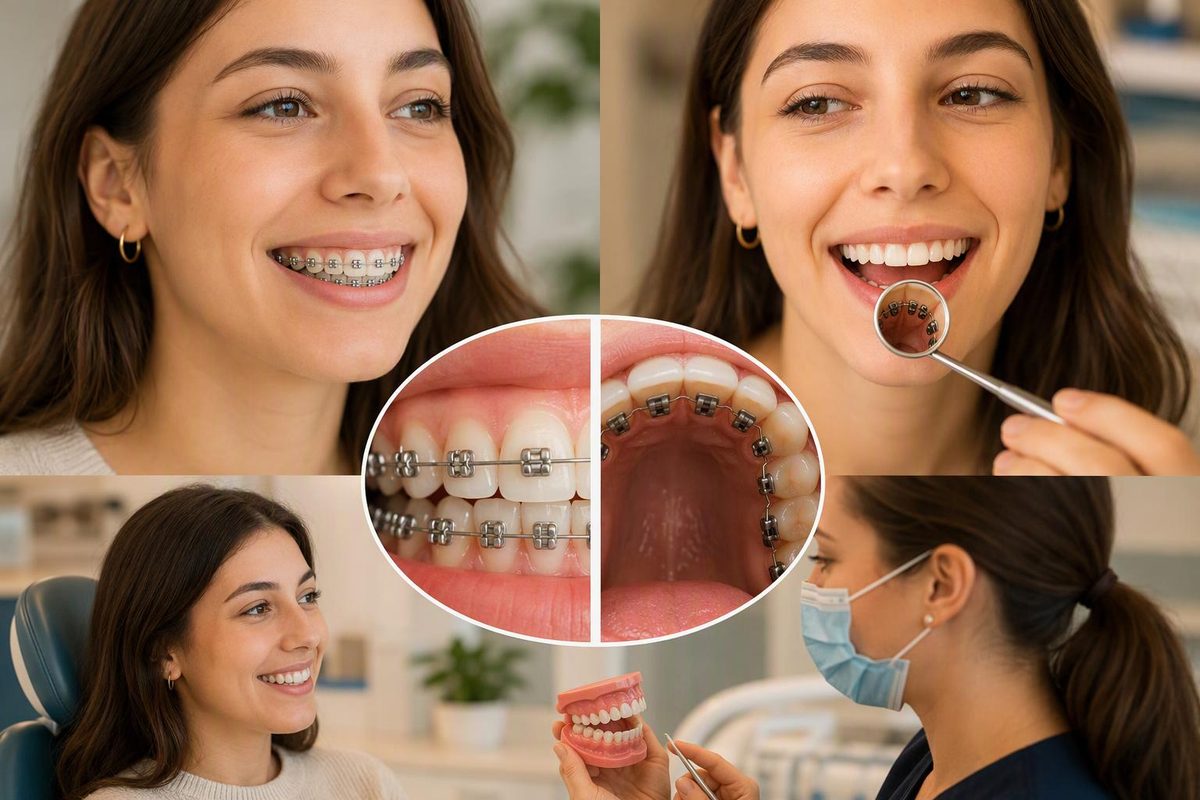
Traditional braces and lingual braces are both fixed appliances: brackets stay bonded to the teeth while wires, and sometimes elastics, apply force to move them. The defining difference is placement. Traditional—or labial—braces sit on the fronts of the teeth; lingual braces sit on the tongue side.
That hidden position makes lingual braces much less visible from the front. The trade-offs are usually a higher price, more contact with the tongue, a greater chance of speech difficulty early in treatment and harder access for cleaning.
Traditional vs lingual braces at a glance
| Decision factor | Traditional front braces | Lingual braces |
|---|---|---|
| Visibility | Metal brackets and wires are conspicuous; ceramic brackets can be subtler | Mostly concealed behind the teeth |
| Daily wear | Fixed in place, so treatment does not depend on remembering to wear trays | Also fixed in place |
| Early irritation | More likely around the lips and cheeks | More likely around the tongue |
| Speech | Usually less interference | Speech difficulty is more likely, particularly during adaptation |
| Cleaning | Brackets are easier to see and reach | Inner placement can be harder to inspect and clean |
| Cost | Usually the lower-cost option | Usually more expensive |
| Availability | Widely offered | Fewer providers offer it; relevant experience matters |
| Treatment time | Depends on the diagnosis and plan | Do not assume it will be faster or slower; comparative evidence is limited |
| After treatment | Retainers required | Retainers required |
The main reason to choose lingual braces is appearance
Because the brackets are behind the teeth, lingual braces are largely hidden in ordinary face-to-face interactions. The British Orthodontic Society calls them “virtually invisible” and notes that, as fixed appliances, they allow greater three-dimensional control than removable treatments.
They are not literally invisible in every situation: parts may be noticeable when you open your mouth widely. But for someone who wants fixed treatment and finds front-facing brackets unacceptable, lingual braces offer a meaningful aesthetic advantage.
Traditional metal braces remain conspicuous. Tooth-colored ceramic brackets reduce the contrast, although they still sit on the front surfaces. See metal vs ceramic braces if you want a less visible fixed option without placing the appliance behind the teeth.
Lingual braces shift the irritation toward the tongue
Both systems can cause aching or tooth tenderness after fitting and adjustments. Bracket placement changes where soft-tissue irritation is most likely: front braces can rub the lips and cheeks, while lingual brackets occupy space normally used by the tongue.
A systematic review found similar short-term overall pain with lingual and labial appliances. Lingual treatment was associated with more tongue pain, less lip and cheek pain, and a greater likelihood of speech difficulty. However, the review included only six small studies—four rated medium quality and two low quality—and most followed patients for no more than three months. Its estimates should not be treated as a personal forecast (systematic review).
This matters if your work depends heavily on speaking, such as teaching, broadcasting, performing, sales or frequent presentations. Ask what speech changes the provider sees with the specific lingual system proposed and what support is available if adaptation is difficult.
Cleaning takes care with either option
Plaque and food can collect around any fixed bracket. Traditional brackets are easier to see in a mirror, while the position of lingual brackets can make them harder to inspect and reach. The American Association of Orthodontists describes lingual braces as more challenging to clean. Its general fixed-brace guidance recommends a soft-bristled toothbrush, fluoride toothpaste and suitable tools for hard-to-reach areas (AAO braces guide).
Do not assume that hidden brackets remove the risk of enamel damage. One small study found fewer new white-spot lesions with lingual treatment, but the adverse-effects review found the evidence insufficient to compare cavities or oral hygiene reliably. Bracket position does not replace careful brushing, interdental cleaning and regular dental checkups.
Can lingual braces achieve the same result?
Lingual systems can achieve substantial tooth movement, and published studies report promising results for meeting customized treatment objectives. But a 2024 systematic review found that most of the available studies were retrospective, sample sizes were often small, appliances and methods varied, and risk of bias was substantial. The authors concluded that larger clinical trials are needed (effectiveness review).
The practical conclusion is not that front and lingual braces are interchangeable in every case. Suitability depends on the diagnosis, movements required and the provider’s experience with the proposed system.
Lingual treatment is also less commonly offered. In a U.S. survey, only 85 orthodontists responded and about one-quarter said they used lingual braces. Among the 21 users, most treated fewer than 10% of their cases this way. Respondents identified patient discomfort, cost, longer chair time and technical difficulty as leading challenges (practitioner survey). The low response count means those percentages should not be treated as a national estimate, but the findings help explain why system-specific experience is worth asking about.
Lingual braces usually cost more
There is no useful universal price: fees vary by location, case complexity, treatment length, appliance system and what the quote includes. The direction of the difference is clearer. The AAO says lingual braces are usually more expensive, while the British Orthodontic Society says private fees vary by complexity, location and provider experience and that lingual techniques cost more (BOS patient guidance).
Compare written, case-specific quotes rather than advertised starting prices. Ask whether each quote includes:
- records, scans and treatment planning;
- one dental arch or both;
- routine appointments and emergency repairs;
- replacement brackets or custom components;
- additional appliances or coordination with other dental care;
- removal, retainers and post-treatment checks;
- financing charges and any assumed insurance benefit.
For wider budgeting context, see braces costs without insurance. A higher quote can still be the clearer deal if it includes services excluded from a cheaper one.
Do lingual braces take longer?
Do not accept a blanket promise that hidden braces are faster—or assume they must be slower. Comparative evidence is too limited and varied to establish a universal rule. Case complexity, required tooth movements, missed visits, breakages and biological response may all affect the schedule.
Ask for an estimated range and the reasons your case could exceed it. General fixed-brace schedules often run for many months and sometimes years; braces treatment time is better understood by complexity than by a single average.
Which option is the better fit?
Traditional front braces are usually the practical choice if cost, broad provider availability, easier access for cleaning or minimizing speech interference matters more than concealing the appliance.
Lingual braces may justify the premium if front-facing brackets are a deal-breaker, fixed treatment suits the planned movements and a provider experienced with the system considers it appropriate. You also need to accept possible tongue irritation, speech adaptation and more difficult cleaning.
At a consultation, ask:
- How many cases have you treated with this specific lingual system?
- Why is it suitable for the movements I need?
- Would you recommend full lingual treatment or a mixed approach, such as lingual braces on only one arch?
- How do the front-brace and lingual plans compare on predicted result, risks, appointment time, duration and complete cost?
- Who will perform each part of treatment, and what happens if I cannot adapt to the appliance?
The American Board of Orthodontics similarly recommends discussing treatment scope, alternatives, who performs the work, costs and post-treatment follow-up.
Whichever fixed appliance you choose, treatment does not end when the brackets come off. Teeth can shift afterward, so include retainers and eventual replacements in the commitment. Your prescribed schedule may change over time; see how long retainers are worn after braces. Final appliance selection requires an assessment by a qualified dental professional.