
Invisalign Specifix vs Regular Attachments
Compare printed Specifix and molded composite attachments by appearance, bonding, removal, lingual use, evidence, and case fit.
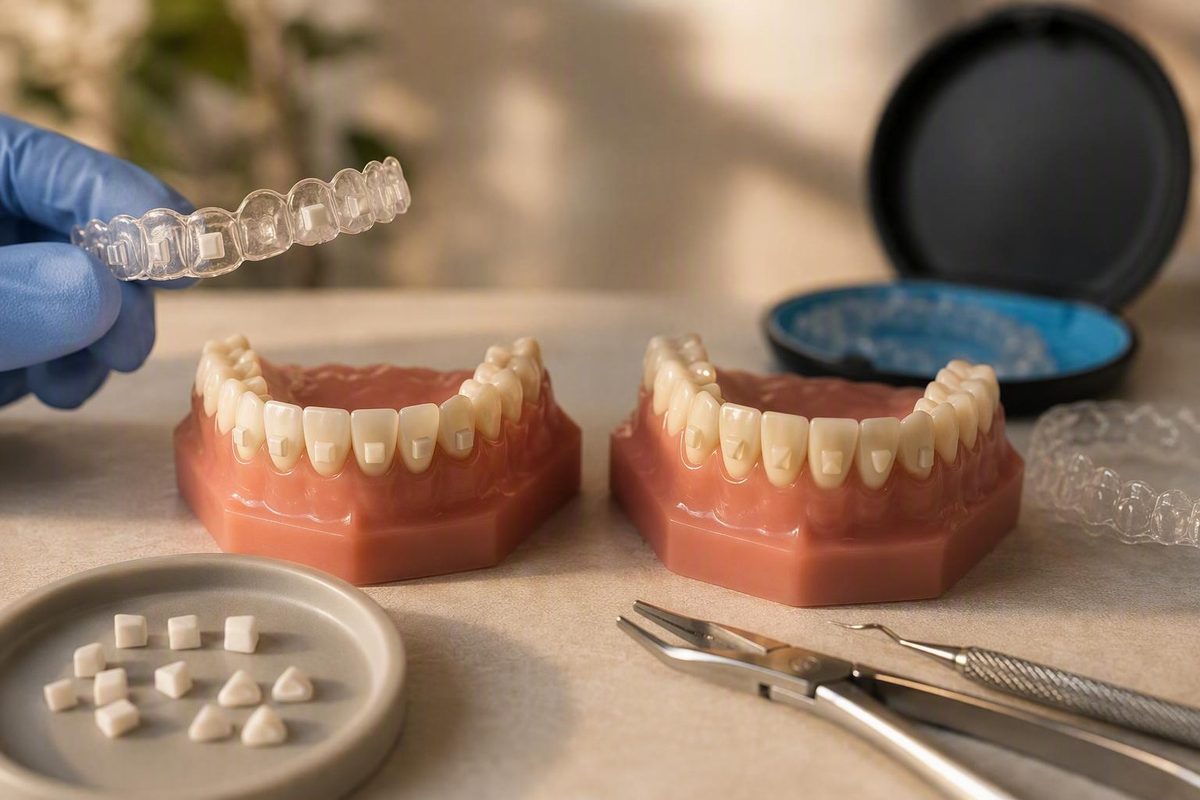
Invisalign Specifix attachments are finished, fully cured 3D-printed pieces bonded in their planned positions; regular attachments are molded directly on teeth by curing composite inside a transfer template. Specifix may make fabrication and placement more consistent, but current evidence does not prove better tooth movement, shorter treatment, fewer refinements, lower failure rates, or better final results. Lingual Specifix attachments were not available in the August 2026 clinical report, so some cases still require conventional composite attachments.
Choose what matters most to you, then sort the comparison and generate questions for your orthodontist.
Compare what changes at placement, during wear and at removal. Select your priority for a tailored result.
— means the article supplies no comparative measurement or current confirmation. Click a column heading to sort methods by that field.
| Method ↕ | Visibility ↕ | Staining Evidence ↕ | Placement Workflow ↕ | Removal ↕ | Lingual Availability ↕ | Evidence Position ↕ |
|---|---|---|---|---|---|---|
| Invisalign Specifix Prefabricated proprietary photopolymer | Translucent or tooth-blending product description; not invisible | Favorable claims; direct comparative measurements — | Finished, fully cured piece arrives in a positioning accessory; isolation, adhesive control, seating and verification remain | Affiliated clinician described angled bracket-removal pliers; comparative time, enamel effects and residual adhesive — | Unavailable in the August 14, 2026 report; confirm current support | New commercial workflow; manufacturer data and two affiliated cases; outcome superiority unproven |
| Regular Composite Template Chairside-molded dental composite | Tooth-colored; varies by shade, size, tooth, lighting, staining and wear | May stain or wear; direct Specifix comparison — | Composite is loaded into a template well, seated, cured, inspected and cleaned; possible overfill, underfill, voids or flash | Professional removal followed by composite cleanup as needed | May be planned facially or lingually when clinically appropriate | Widely established workflow; no evidence that it is universally inferior |
| 3M Clarity Precision Grip | — | — | — | — | — | No product-specific comparison was supplied in the article evidence |
- Which teeth would receive Specifix and which would receive composite?
- What case-specific benefit do you expect beyond a different bonding workflow?
- What replacement method would you use if an attachment detached?
- Are any planned attachments lingual, and is Specifix supported there now?
Sources: Align Technology announcement; August 14, 2026 affiliated clinician report; FDA 510(k) K252870. No independent head-to-head outcome measurements or 3M product data were supplied.
Specifix And Regular Attachments Serve The Same Mechanical Purpose
Both attachment types create a raised surface that the aligner can engage. This can help the tray stay seated or apply force in a useful direction.
The difference is principally how the feature is made and transferred. A Specifix attachment’s shape, size, and intended location come from the orthodontist’s digital treatment plan. Align Technology describes the system as designed to reduce variation in attachment size and placement and streamline bonding (Align Technology’s Specifix announcement).
A regular attachment is usually made from tooth-colored dental composite. The clinician loads uncured composite into an attachment-shaped well in a transfer template, seats the template and light-cures the material. The template is both mold and transfer device. A clinician-authored report contrasts this established method with the prefabricated Specifix workflow (clinical report on Specifix placement and removal).
| Feature | Specifix | Regular Composite |
|---|---|---|
| State before bonding | Finished and fully cured | Uncured composite in a template well |
| Material | Proprietary photopolymer described as translucent and tooth-blending | Usually tooth-colored dental composite |
| Formation | 3D printed before the visit | Molded and cured on the tooth |
| Transfer | Ready-to-bond positioning accessory | Template that also acts as the mold |
| Main potential advantage | Standardized fabrication and delivery | Established, adaptable workflow |
| Clinical superiority | Not established | No head-to-head evidence establishes universal superiority |
Manufacturing a finished shape in advance may avoid overfill, underfill, trapped air, flash or incomplete reproduction during chairside molding. These are possible process issues, not inevitable problems with conventional attachments. Skilled teams routinely place composite attachments successfully.
Specifix does not eliminate technique sensitivity. Isolation, adhesive control, accurate positioner seating and verification of the bond remain important. A precisely printed piece can still be bonded incorrectly if the tooth is contaminated or the positioning accessory does not seat fully.
Placement Removes The Chairside Molding Step
Conventional composite placement generally involves preparing and isolating the tooth, applying a bonding agent, loading composite into the relevant template well, seating the template, curing the material, removing the template, and inspecting and cleaning the result. This is consistent with the established clear-aligner workflow described in the clinical literature (review of attachment design and biomechanics).
Specifix supplies the attachment’s main body already printed and cured. The clinician still prepares and isolates the tooth, applies the appropriate bonding material, seats the positioning accessory accurately, completes the bond and confirms aligner engagement. The clinician does not fill a well and use it to form the main attachment body.
Align presents this as a more consistent, streamlined process. Its cited support for attachment-volume precision included company bench testing conducted in August 2025. Bench testing can assess manufactured dimensions under controlled conditions, but it is not an independent trial in patients.
No supplied evidence quantifies the average time saved over a complete appointment. A fair comparison would include preparation, placement, cleanup, verification, later rebonding and eventual removal—not just the number of initial bonding steps.
Neither Type Is Necessarily Less Visible
Regular attachments are tooth-colored. Specifix uses a proprietary photopolymer described by its manufacturer and an affiliated clinician as translucent or tooth-blending.
Neither option is invisible. Visibility depends on the tooth, front or back placement, attachment size and contour, underlying shade, lighting, viewing distance, whether the aligner is worn, and surface staining or wear.
Claims that Specifix looks better or resists staining are product descriptions and clinical observations. No independent comparative appearance or staining measurements were supplied. The same caution applies to claims of closer aligner engagement and greater comfort.
Either type may feel prominent when the tray is removed. With the aligner inserted, the plastic covers the attachment, although its contour may remain visible or palpable. Comfort also varies with location, size, surface finish, tray fit and oral anatomy.
Attachments create extra contours where plaque and food can collect. Careful brushing around their margins and cleaning between teeth are necessary with either system. Do not pick at an attachment or test it repeatedly with a fingernail.
Removal Is Different, But Comparative Safety And Speed Are Unknown
Regular composite attachments are removed professionally, followed by cleanup of remaining material as needed.
The affiliated Specifix clinical report describes using angled orthodontic bracket-removal pliers. Align’s selected testimonials have also described removal without a high-speed handpiece. This does not prove that removal is always faster, that rotary instruments are never needed, or that less adhesive remains.
No supplied quantitative comparison establishes average removal time, residual bonding material, enamel surface effects, patient discomfort, rotary-instrument use or complication rates. Neither attachment type should be removed at home.
If an attachment detaches, do not glue it back on or remove other attachments. Continue following the practice’s instructions for the current tray and contact the treating practice, identifying the affected tooth. Invisalign’s patient guidance also advises contacting the orthodontist when an attachment falls off (Invisalign attachment overview).
The response depends on the tooth, intended movement, treatment stage, aligner fit and next appointment. Available evidence does not establish a standard Specifix replacement procedure or show that every lost printed piece will be replaced with another printed piece rather than composite.
Better Shape Reproduction Does Not Prove Better Tooth Movement
Attachment shape matters because its active surface affects how the aligner contacts it and the direction in which force is applied. Attachments may support rotation, extrusion, intrusion, torque, root control, distalization, expansion or retention. Those functions are not guarantees that a tooth will complete its planned movement.
A prefabricated piece may closely match its manufactured shape without making a tooth follow its digital path more accurately. Attachment reproduction and tooth-movement accuracy are separate questions.
Treatment also depends on bonding position, aligner fit, engagement, crown and root anatomy, periodontal support, simultaneous movements, staging, force design, auxiliaries, biological response and how consistently the aligners are worn. Specifix addresses only part of that chain.
The supplied product-specific evidence consists mainly of an Align press release, company bench testing or data on file, selected clinician testimonials and a clinician-authored report involving two cases. The cases included favorable observations such as close aligner fit and favorable anterior root findings after 12 months. They also used interproximal reduction, elastics, a frenectomy, staged aligners and broader digital planning. Both patients were proceeding into additional treatment stages rather than being presented with fully documented final outcomes.
The author disclosed an educator and adviser relationship with Align and participation in technical design assessment. The observations can illustrate the workflow, but two uncontrolled cases cannot isolate Specifix’s contribution or show what would have happened with composite attachments.
A 2024 paper examined reproduction accuracy using printed and traditional approaches, but the supplied material does not contain its numerical results or conclusions. It also does not identify the tested system as commercial Specifix; its illustrated printed protocol used a thermoformed transfer template and flowable composite (2024 printed-attachment study). Generic research is not direct evidence for Specifix unless the material, manufacturing process, transfer method and workflow match.
Current evidence therefore does not demonstrate more accurate movement, better tracking, fewer refinements, shorter treatment, lower detachment rates, greater durability or superior completed outcomes.
Lingual Attachments And Unsupported Cases May Still Use Composite
A clinician report published August 14, 2026 stated that lingual Specifix attachments were unavailable at that time. When a treatment plan included attachments on the inside surfaces of teeth, a conventional attachment template was supplied.
This is a date-specific limitation rather than proof of a permanent restriction. Patients should ask whether lingual support has changed in their market.
Composite may also remain appropriate when Specifix is unavailable locally, the planned surface or attachment is unsupported, the practice has not adopted the workflow, or the orthodontist prefers composite for a particular clinical reason. A single plan could therefore include a different workflow for some teeth.
Align previewed Specifix in April 2026 and anticipated availability around mid-2026, subject to regulatory approvals and clearances in individual markets. That did not establish universal access. Availability depends on country, rollout and practice adoption.
The FDA database lists the Invisalign Specifix Attachment System under 510(k) K252870, with a “Substantially Equivalent” decision dated October 9, 2025 (FDA 510(k) record). Substantial equivalence is a regulatory determination. It does not establish that Specifix is better, safer, faster or more effective than composite attachments.
Specifix Is Not A Synonym For SmartForce Or Optimized
Specifix identifies the prefabricated 3D-printed attachment and positioning workflow.
SmartForce is Invisalign terminology associated with attachment features used in its force-delivery system. It should not automatically be treated as another name for Specifix.
Optimized attachment describes geometry selected by the treatment system for a planned movement. Conventional attachment commonly describes a standard shape, such as a rectangular or ellipsoidal attachment, selected and oriented by the clinician.
The distinction is straightforward:
- Specifix versus regular compares fabrication and transfer.
- Optimized versus conventional compares design selection.
Research comparing optimized SmartForce geometry with clinician-selected conventional geometry does not compare Specifix with chairside-molded composite. A result about geometry cannot prove that prefabricating the same geometry improves clinical outcomes.
“Button” can also be ambiguous. It may mean a composite aligner attachment, a Specifix attachment, a bonded elastic button or another engagement feature. The treatment team can identify which feature is planned and how it should be cared for.
The Choice Depends On Case Fit, Not A Proven Outcome Advantage
Specifix is a reasonable option when the orthodontist wants a prefabricated attachment, the planned teeth and surfaces are supported, and the system is available. Conventional composite remains an established choice and may be required for lingual placements or other unsupported situations.
Ask the orthodontist which teeth would receive each type, why that workflow suits the planned movements, whether inside surfaces are currently supported, and what happens if a printed piece detaches. Also ask how the attachments will be removed, whether appointment length is expected to change and whether there is an added fee. No comparative patient-cost figure was supplied.
The most defensible expected benefit is cleaner, more standardized fabrication and transfer—not better biological tooth movement. Important unknowns remain: controlled placement-time savings, independent placement accuracy, bond-failure rates, staining and wear, comfort, hygiene effects, removal time, residual adhesive, enamel effects, refinement rates, treatment duration, final tooth-position accuracy and completed outcomes.
Frequently Asked Questions
Are Specifix Attachments Proven To Work Better?
No. Current evidence supports a different fabrication and bonding workflow, but it does not prove better movement, shorter treatment, fewer refinements, lower failure rates or superior results.
Can Specifix Go On The Inside Of Teeth?
The August 14, 2026 clinician report said lingual Specifix attachments were unavailable then and conventional templates were supplied for lingual attachments. Ask whether support has since changed for your market and planned tooth surfaces.
Does FDA Clearance Establish Clinical Superiority?
No. The FDA’s substantially equivalent decision under the 510(k) pathway does not establish that Specifix is safer, faster or more effective than regular attachments.
Which Type Costs More?
The supplied evidence provides no comparative patient-price figure. Fees, if any, are practice-dependent, so ask whether Specifix changes the quoted treatment cost.
What Should I Do If An Attachment Comes Off?
Contact the treating practice and follow its directions for the current tray. Do not rebond it or remove another attachment yourself. Ask whether a lost Specifix piece would be replaced with Specifix or conventional composite.