
Invisalign Overbite Before vs After: How to Judge Photos
An immediate after-photo cannot show whether results stayed stable during retention. Useful records include side views, vertical-overlap measurements and follow-up.
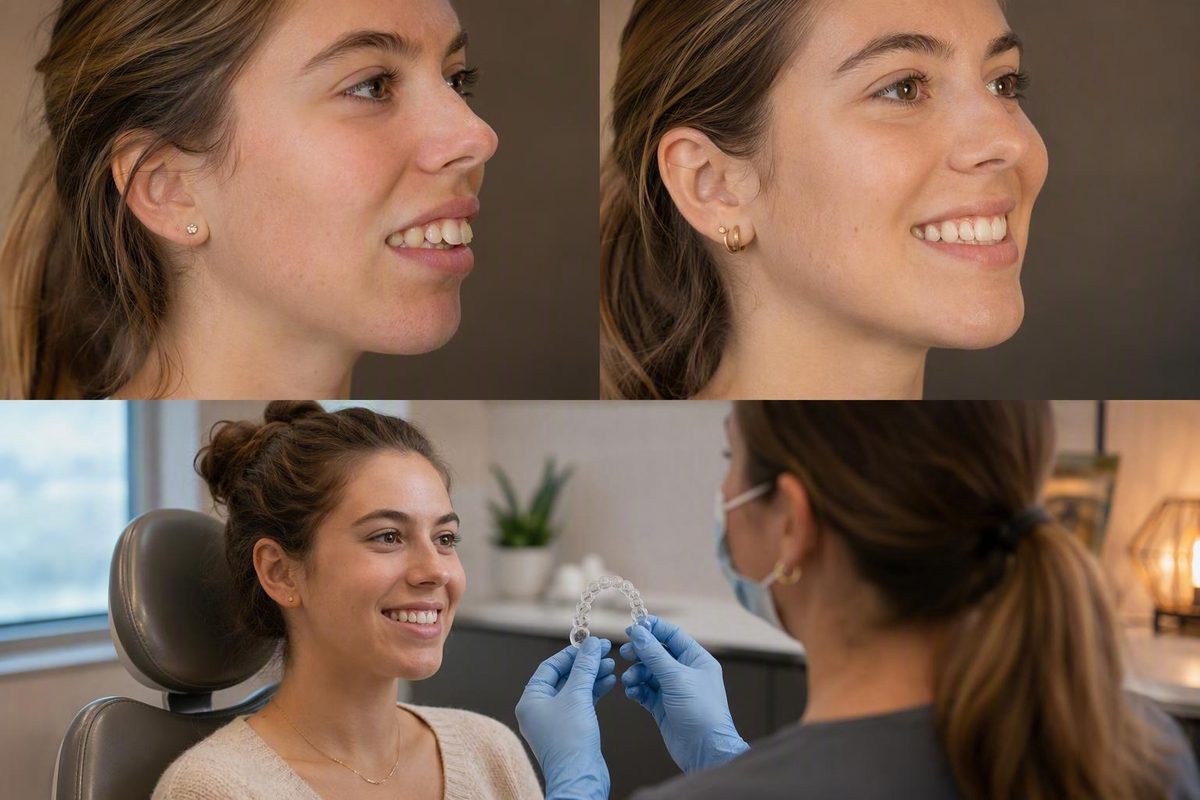
Searching for “Invisalign overbite before and after” usually produces dramatic smile photos.
A finished smile can reflect several improvements at once, including gap closure, crowding relief, tooth rotation, overjet reduction, and overbite correction. An immediate after-photo says nothing about whether the result remained stable during retention.
The useful question is therefore not simply, “Does the smile look better?” It is: Do the records document a measured, clinically meaningful change in the bite, and do they explain how that change was achieved?
What an Invisalign overbite result should actually demonstrate
An overbite is when your upper front teeth overlap your lower front teeth vertically Are Braces or Invisalign Better for Overbites?. It should not be confused with overjet, which describes how far the upper front teeth project horizontally beyond the lower front teeth.
That difference matters when interpreting photographs. An image showing that the upper incisors project less may document improvement in overjet, but it does not directly prove that vertical overbite improved.
A meaningful Invisalign overbite before-and-after comparison may show:
- Less vertical coverage of the lower incisors by the upper incisors
- More of the lower front teeth visible when the teeth are fully together
- Improved contact between the upper and lower teeth
- A finished bite in which the front and back teeth meet as planned
- Objective baseline and final measurements confirming the change
These signs still need context. Straighter incisors can make the lower teeth more visible without fully correcting the bite. Closing a gap or aligning crowded teeth may create an attractive smile while leaving excessive vertical overlap. Cosmetic improvement and bite correction can occur together, but one does not prove the other.
Why a front-facing smile is rarely enough
A conventional smiling portrait is intended to show appearance, not the way the teeth meet. The patient may have the teeth slightly apart, the lips may conceal the lower incisors, or the camera may sit above or below the dental midline.
More useful records include:
- A frontal facial view with consistent head posture
- A profile view
- A frontal intraoral view with the teeth fully together
- Right and left side-bite views
- Upper and lower arch views when relevant
- Matching magnification, lighting, and camera angle
- Measured starting and finishing vertical overlap
The before and after records should capture the same bite position.
Be cautious with universal labels such as mild, moderate, or severe based on one percentage or millimeter threshold. The provider material in the available evidence uses inconsistent classification systems. Diagnosis involves more than a single number: the clinician must also consider tooth contact, jaw relationships, available space, age, growth status, and the movements required to produce a stable result.
The two best-documented overbite examples in the available evidence
The most detailed patient examples in the available material come from Invisalign itself. The brand identifies the patients’ ages, accompanying alignment problems, treatment durations, costs, and insurance contributions. Both patients were compensated, however, and the cases were selected for promotional publication. They are individual marketing examples, not representative clinical evidence or independent verification.
| Compensated, brand-published case | Starting description | Reported treatment time | Reported total cost | Reported insurance or benefits | Reported patient or family payment |
|---|---|---|---|---|---|
| Nakia, age 21 | Gapped teeth and overbite | 9 months | $3,000 | $1,500 | $1,500 |
| Maliana, age 14 | Crowding and overbite | 24 months | $7,000 | $5,600 through benefits from both parents’ insurance plans | $1,400 |
These figures and disclosures come from Invisalign’s compensated before-and-after patient feature. They are not average prices, expected insurance benefits, typical timelines, or promised outcomes.
What Nakia’s case can—and cannot—show
Nakia was 21 and was described as having both gapped teeth and an overbite. The visible transformation includes spacing correction, which can substantially change the appearance of a smile independently of overbite correction.
The case shows that the brand presented aligner treatment as addressing both concerns during the reported treatment period. It does not disclose how much vertical overlap changed, whether the overbite was primarily dental or skeletal, or which movements produced the finished appearance.
What Maliana’s case can—and cannot—show
Maliana was 14 and was described as having crowding as well as an overbite. Crowding relief and alignment can produce a major visual change without isolating how much of the transformation came from overbite correction.
Age is also relevant because a teenager may still be growing.
The crucial information both cases omit
Neither published example provides:
- Starting and finishing vertical-overlap measurements
- A dental, skeletal, or combined diagnosis
- Cephalometric or other diagnostic findings
- Confirmation that the photographs used a standardized bite position
- Details of attachments, elastics, bite ramps, or other auxiliaries
- The number of refinement rounds
- Actual aligner and elastic wear adherence
- Post-treatment records after a period of retainer use
Consequently, neither case should be described as typical, independently verified, or proof that another patient will obtain the same result, price, insurance payment, or timeline.
This article does not reproduce the patient images. A publisher wishing to use them should follow its own image-rights process and provide a caption identifying the brand source, promotional context, and compensation disclosure.
A credibility checklist for before-and-after photos
A useful gallery should let you inspect the bite, not merely admire the smile. Apply the following checks before treating an online transformation as meaningful evidence.
1. Do the photography conditions match?
Compare:
- Camera angle: Is the lens at the same height and position?
- Magnification: Are the teeth shown at the same scale?
- Lighting: Do shadows or highlights conceal tooth contours?
- Expression: Is the smile equally broad in both images?
- Head posture: Is the chin raised, lowered, turned, or pushed forward?
- Bite position: Are the teeth fully and consistently together?
If several conditions differ, the images may still depict a real patient, but they become much less useful for assessing the amount of bite change.
2. Are there enough views?
Look for a frontal smile, facial profile, frontal intraoral image, and right and left side-bite views. Arch views, scans, and imaging may also be relevant to clinical planning, although they are not normally included in a public gallery.
A single front-facing portrait can conceal vertical overlap. Side-bite images show more clearly how the upper and lower arches meet. A profile adds context, but it does not replace intraoral measurements.
3. Are measurements and diagnosis disclosed?
Ask whether the case supplies:
- Baseline and final vertical overlap
- Dental, skeletal, or combined diagnosis
- Starting severity described in clinically meaningful terms
- Age and growth status
- Treatment duration
- Attachments, elastics, bite ramps, or other auxiliaries
- Refinement rounds
- Retainer protocol and follow-up interval
Without those details, it is difficult to know whether a superficially similar smile represents a comparable case.
4. Is the visual an achieved result or a forecast?
Marketing pages may combine patient photographs with digital simulations, illustrations, stock images, and generic treatment animations. A digital preview represents intended tooth movements; it is not a guaranteed biological result. Provider material specifically describes such scans as possible previews rather than substitutes for a full examination or promises of the final outcome.
Check the caption and surrounding text. “Potential result,” “simulation,” and “treatment preview” do not mean completed treatment. Likewise, a generic image labeled “overbite” does not document a patient’s diagnosis, mechanics, or result.
5. Is selection or editing disclosed?
Some galleries list numerous patients without saying which ones had an overbite.
Editing deserves separate attention. In one practice gallery, some supplied image filenames include the word “retouched.” That does not show what was edited or establish that the bite was altered. It does reinforce the need for explicit editing disclosure and standardized records rather than assumptions based on polished promotional images (view the gallery context).
A credible gallery should distinguish ordinary color or exposure correction from changes that could alter apparent tooth contours, gum appearance, alignment, or visibility.
6. Is there follow-up after retention?
A photograph taken when attachments are removed documents an immediate result only. It cannot establish that the teeth remained in the same positions.
Stronger case documentation would include the retention protocol, the interval between active treatment and follow-up records, reported retainer adherence, and any relapse or additional treatment. Such detail is uncommon in promotional galleries, which is one reason they should be treated as illustrations rather than forecasts.
Dental versus skeletal overbite: the distinction that shapes candidacy
Two people can appear to have similar front-tooth overlap yet require very different treatment.
A dental overbite primarily concerns tooth position. A skeletal overbite involves the underlying relationship or structure of the jaws. Some patients have both dental and skeletal components.
Orthodontic-practice guidance commonly presents mild-to-moderate tooth-position-related overbites as more suitable for aligners than substantial skeletal or otherwise complex discrepancies. The same guidance generally describes braces as more predictable for some severe, skeletal, or mechanically demanding cases. That is provider guidance rather than definitive comparative proof for every overbite (see the provider comparison).
An orthodontic assessment may consider:
- The amount and nature of vertical overlap
- Whether the cause appears dental, skeletal, or combined
- How the front and back teeth contact
- Available space in each arch
- Tooth inclinations and planned movements
- Facial and jaw relationships
- Age and remaining growth
- Whether the intended movements are feasible with aligners
- Whether another appliance or procedure may be needed
“Mild to moderate” should not be treated as an automatic qualification for clear aligners. A severity label does not describe every movement required or how predictable that movement will be for a particular patient.
Growth changes the discussion for teenagers
A growing teenager with a jaw-related discrepancy may be assessed for growth-related features or a separate functional appliance. That does not mean every teenager needs growth modification, or that any aligner feature can correct every jaw discrepancy.
The available provider evidence lists functional appliances, expansion, temporary anchorage, and, in selected circumstances, corrective jaw surgery among possible additions for skeletal cases. These are case-dependent options, not routine parts of every overbite plan (review the provider’s stated treatment options).
Growth status and jaw relationships therefore require diagnostic evaluation rather than visual guessing from a smile photograph.
Adults with substantial skeletal discrepancies
For an adult with a substantial skeletal component, a clinician may discuss orthodontic tooth movement, braces, aligners with auxiliaries, temporary anchorage, or surgical evaluation. Which options are realistic depends on the diagnosis and the treatment goal.
Aligning teeth may improve their relationship without fully changing an underlying jaw discrepancy. If the desired result cannot be produced adequately through tooth movement, the clinician may discuss a combined approach or referral for further evaluation. The available evidence does not support a rule that every skeletal overbite requires surgery or that every one can be treated without it.
Who may not be an Invisalign-only candidate
An Invisalign-only plan may be unsuitable—or may not be the most predictable option—for someone with:
- A major skeletal jaw discrepancy
- Highly complex vertical or root movement
- A bite requiring mechanics better delivered with fixed appliances
- A possible need for temporary anchorage, another appliance, or surgical evaluation
- Limited ability or willingness to follow a removable-appliance schedule
- Repeated difficulty wearing prescribed elastics or keeping trays seated
- Dental conditions that need to be addressed before orthodontic movement
This does not necessarily exclude aligners from every stage of care. It means the appliance choice should follow the diagnosis rather than a preference for less visible treatment.
How Invisalign overbite treatment may work from scan to refinement
Overbite treatment is more than a box of trays. The process may involve examination, digital planning, sequential force application, monitoring, refinement, finishing, and retention.
1. Clinical examination and diagnostic records
The provider examines how the teeth and jaws relate, how the arches close, whether space is available, and which movements may be required. Records may include photographs, a digital scan, and appropriate imaging.
The resulting plan should identify more than a cosmetic goal. Useful questions include what is causing the overbite, which contacts are intended at the end, what limitations are foreseeable, and what alternatives exist if aligners cannot provide adequate control.
2. Digital scan and individualized planning
A digital model records tooth surfaces and the bite relationship. The provider then plans a sequence of movements and may show a simulated progression.
That simulation is a communication and planning tool, not a guaranteed result. The actual result must be assessed through clinical progress records and the achieved bite—not by assuming that the final animation frame will occur exactly as displayed.
3. Sequential aligners
Successive trays apply planned pressure in selected areas. Different stages may perform different tasks, such as creating space, aligning crowded teeth, closing gaps, changing incisor position, coordinating the arches, or refining vertical overlap.
Patients should change trays according to the prescribed schedule.
4. Attachments and other programmed features
Attachments are small, tooth-colored shapes bonded to selected teeth. They provide surfaces against which an aligner can apply or control force.
Depending on the case, a plan may also include:
- Bite ramps, intended to influence how teeth contact
- Precision cuts or features, which provide sites or geometry for added mechanics
- Growth-related features or appliances for selected growing patients
- Other auxiliaries chosen by the treating clinician
Provider material describes attachments, bite ramps, precision cuts, and elastics as possible tools for overbite treatment. Their availability does not make every severe or skeletal case suitable for aligners alone.
5. Prescribed elastics
Orthodontic elastics can add force between the upper and lower arches. Placement, strength, and wear schedule are prescribed for an individual plan.
Patients should not use household rubber bands or copy an elastic configuration found online. Orthodontic-provider guidance warns that improvised rubber-band treatment can damage teeth, roots, and gums (see the provider safety warning). If a hook breaks or the pattern is unclear, contact the treating office.
6. Wear and progress checks
Provider guidance commonly instructs patients to wear aligners approximately 20–22 hours per day, removing them as directed for meals, non-water drinks, and oral hygiene. Treatment progress depends in part on following the prescribed tray and elastic schedule.
The clinician may evaluate tray fit, tooth tracking, vertical overlap, horizontal projection, arch coordination, and tooth contacts.
7. Refinement
A refinement is an additional scan and series of aligners used when more movement or finishing is needed.
Refinements can nevertheless extend treatment. In a randomized trial involving selected patients with relatively simple malocclusions, every Invisalign participant had at least one refinement scan, and each refinement added approximately four weeks. The study was not an overbite-specific effectiveness trial, so that experience should not be generalized to every overbite case (read the randomized trial).
8. Finishing and retention
The clinician must assess the achieved alignment and contacts, determine whether further finishing is needed, and prescribe retention.
If the achieved bite begins to differ from the digital plan, ask:
- Which teeth are not tracking?
- Is the aligner fully seated?
- Has measured vertical overlap changed as expected?
- Are the attachments intact?
- Are prescribed elastics being worn correctly?
- Should the current tray be worn longer?
- Is a rescan or refinement needed?
- Has the original movement goal become unrealistic?
- Would fixed appliances or another auxiliary offer better control?
These questions focus the discussion on the clinical discrepancy rather than the cosmetic preview.
How long visible change and completed correction can take
There are at least four different milestones:
- First noticeable tooth movement
- Visible improvement in the smile
- Completed active bite correction, including refinements
- Stability during retention
They are not interchangeable. Gaps may begin closing or incisors may look straighter while the overbite remains unfinished. Conversely, changes in tooth contacts may not be obvious in a selfie.
Provider estimates vary widely. Some provider pages describe treatment as taking approximately six months in selected mild cases, commonly 12–24 months for more involved treatment, and potentially longer than two years in complex cases. These are broad promotional planning ranges, not an evidence-based average or a dependable prediction for an individual patient (see one provider’s stated ranges and limitations).
The two compensated brand cases illustrate that reported duration can vary, but they should not be used as benchmarks. One involved spacing and the other crowding, and neither disclosed baseline overbite measurements, mechanics, refinement count, or retention outcome.
Treatment duration may be affected by:
- Dental versus skeletal cause
- Number and complexity of planned movements
- Age and growth status
- Available space
- Prescribed elastics or other auxiliaries
- Daily aligner and elastic wear
- How closely the teeth follow the plan
- Individual treatment response
- Broken or lost trays and attachments
- Refinement rounds
- Finishing standards and treatment goals
The available evidence does not establish a dependable week or tray number at which an individual will first see improvement. Be wary of promises tied to a precise milestone without an examination and treatment plan.
A case-specific estimate should distinguish the initial aligner series from possible refinements, finishing, and retention. It should also explain which assumptions depend on wear, auxiliary use, and tooth tracking.
Invisalign versus braces for overbite correction
The appropriate appliance is the one the treating clinician expects to deliver the required movements with an acceptable burden and level of control. Appearance is relevant, but it should not override diagnosis.
| Decision factor | Clear aligners | Fixed braces |
|---|---|---|
| Visibility | Usually less conspicuous | More visible, although bracket options vary |
| Removal | Removed for meals and cleaning | Remain attached |
| Eating | No trays during meals, but they must be removed and stored | Food precautions may be required |
| Cleaning | Teeth are accessible after trays are removed | Cleaning around brackets and wires requires additional care |
| Adherence | Depends heavily on daily wear and prescribed elastic use | Fixed placement reduces reliance on remembering trays |
| Complex movement | May require attachments, elastics, bite ramps, refinements, or combined treatment | May be preferred when fixed control is useful |
| Loss or breakage | Trays can be lost or may stop seating | Brackets and wires can break |
| Daily routine | Requires disciplined removal, hygiene, and reinsertion | Requires adapting hygiene and meals to a fixed appliance |
Provider guidance commonly positions aligners for selected dental overbites and braces or combined approaches for substantial skeletal discrepancies or complex movements. This is not an absolute rule. Some challenging cases may incorporate aligners, while some apparently modest cases may be better suited to fixed appliances.
Attachments, bite ramps, precision features, and elastics may extend the range of mechanics available to an aligner plan. They do not convert every jaw discrepancy into an aligner-only problem.
Readers comparing the practical tradeoffs can also review this overview of braces types and clear aligners. Appliance selection for an individual overbite still requires a diagnosis and movement-specific plan.
What the randomized trial actually found
The strongest comparative evidence in the supplied material is a randomized controlled trial of Invisalign with programmed features and attachments versus fixed braces. Among selected patients with relatively simple malocclusions, the groups had similar American Board of Orthodontics Objective Grading System scores at treatment completion and after six months of retention. Braces nevertheless finished treatment a median 0.4 years, or 4.8 months, sooner.
That finding has important limits:
- The study did not report overbite-specific before-and-after measurements.
- Eligibility was restricted to relatively simple cases.
- Patients with several more complex conditions—including open bite, crossbite, and higher overjet—were excluded.
- The findings cannot establish comparative effectiveness for severe or skeletal overbite.
- Retention follow-up lasted only six months.
- Every Invisalign participant underwent at least one refinement scan.
The fair conclusion is not that braces are always faster or that the appliances are equivalent for overbite. The study found similar short-term finishing scores in a restricted sample, while the braces group completed treatment sooner. Appliance choice for an overbite should follow the required movements, expected adherence, and treatment goals—not gallery photographs or visibility preferences alone.
Cost, retention, and questions to ask before treatment
The prices in the earlier comparison table are individual, brand-reported examples. The insurance contributions also differed substantially, with the teenage case reportedly using benefits from both parents’ plans.
Two compensated, selected cases cannot establish what another patient will pay.
Compare quotes by what they include
Ask whether a quoted fee covers:
- Initial examination and diagnostic records
- All planned aligners
- Attachments and their repair or replacement
- Elastics and routine auxiliaries
- Progress scans and visits
- A specified number of refinement rounds
- Replacement aligners
- Emergency visits
- Final records
- Initial retainers
- Retainer checks and later replacements
- Any separate appliance
- Temporary anchorage or other procedures
- Surgical planning and surgical fees, if relevant
- Treatment changes if aligners prove unsuitable
Request the full fee, included services, exclusions, and refinement policy in writing.
Retention is part of the result
Retainers are normally prescribed after active orthodontic treatment to limit post-treatment tooth movement. The type and schedule vary by patient and provider. Provider educational material also emphasizes that retainers are needed after treatment rather than treating the final active tray as the end of care (see the retention explanation).
A photograph taken on the day attachments come off therefore documents only an immediate result. It cannot demonstrate long-term stability. Better evidence includes follow-up records after a meaningful period of prescribed retainer use, together with disclosure of adherence, relapse, and any additional treatment.
Consultation checklist
Bring these questions to an orthodontic consultation:
- What is my measured starting vertical overlap?
- Is the overbite dental, skeletal, or combined?
- What records support that diagnosis?
- Which teeth need to move, and in what directions?
- What result is realistically achievable with aligners alone?
- Will I likely need attachments, bite ramps, elastics, or another appliance?
- How many refinement rounds are included?
- What happens if my teeth do not track the digital plan?
- Why might braces offer better control in my case?
- Is a combined braces-and-aligner approach an option?
- When would temporary anchorage or surgical evaluation be discussed?
- What alternatives exist if I decline the recommended approach?
- What is the complete fee, including records, refinements, and retainers?
- How are lost trays, broken attachments, and emergency visits charged?
- What is the estimated active-treatment range, and what could extend it?
- What retention schedule will follow?
- When will follow-up records be taken to assess stability?
Frequently asked questions
Can Invisalign fix an overbite?
Invisalign can be used for some overbites, particularly when excessive overlap is driven mainly by tooth position. The manufacturer states that its aligners may be used in overbite or deep-bite cases, while also noting that treatment depends on the individual and that other options can include braces or surgery (Invisalign’s overbite overview).
Suitability depends on diagnosis, required movements, jaw relationships, available space, growth status, and the patient’s ability to follow the prescribed aligner and elastic schedule. “Can treat some overbites” does not mean “can treat every overbite with aligners alone.”
Can Invisalign correct a severe or skeletal overbite without surgery?
Some patients with a skeletal component may obtain useful improvement through orthodontic tooth movement, potentially involving aligners, braces, elastics, temporary anchorage, or another appliance. A substantial jaw discrepancy, however, may not be correctable to the desired extent with Invisalign alone.
Growing patients may be assessed for growth-related approaches. Adults with major jaw discrepancies may be offered a combined orthodontic plan or surgical evaluation. Examination and diagnostic records are necessary to determine whether a nonsurgical result is realistic and what compromises it would involve.
How long does Invisalign treatment for an overbite take?
Provider estimates span from approximately six months in selected mild cases to 12–24 months for more involved cases, with complex treatment potentially continuing longer. These figures are broad provider estimates, not a personal forecast or an established average.
The compensated Invisalign examples also reported different treatment lengths, but each patient had another alignment concern and neither case disclosed baseline severity, detailed mechanics, or refinement count. A useful personal estimate should separate the initial tray series from refinements, finishing, and retention.
What is the difference between an overbite and an overjet?
An overbite describes vertical overlap: how much the upper front teeth cover the lower front teeth when the teeth are together.
An overjet describes horizontal projection: how far the upper front teeth sit in front of the lower front teeth.
A person can have one, both, or neither. Because they measure different dimensions, an overjet transformation should not be presented as direct evidence of overbite correction unless the vertical overlap is also documented.
Can I trust Invisalign overbite before-and-after photos?
Treat them as selected examples, not forecasts. Their credibility improves when they include:
- Matched photography
- A consistent closed bite
- Multiple facial and intraoral views
- Measured starting and final overlap
- Dental or skeletal diagnosis
- Age and growth status
- Treatment mechanics
- Refinement information
- Retention follow-up
- Compensation, selection, and editing disclosures
Also check whether the visual is an actual completed case rather than a simulation, illustration, stock image, or generic marketing graphic. If the clinical details are missing, the image may still be interesting, but it is weak evidence for your likely result.
The central lesson is not that one dramatic gallery result predicts another patient’s outcome. The available cases show possible change while leaving crucial questions unanswered about measurements, diagnosis, mechanics, adherence, and stability. Use photographs to begin the conversation, then ask an orthodontist for a measured diagnosis, realistic alternatives, a complete fee and refinement policy, and a long-term retention plan.
Aligner Source provides general educational information rather than individualized diagnosis or treatment planning. As its terms explain, orthodontic treatment decisions belong with your orthodontist.