
How Much Do Retainers Cost to Replace by Type and Arch?
Budget about $100–$550 per arch for many provider-supplied replacements. That means upper or lower, not both. Check if scans, fitting and follow-up are included.
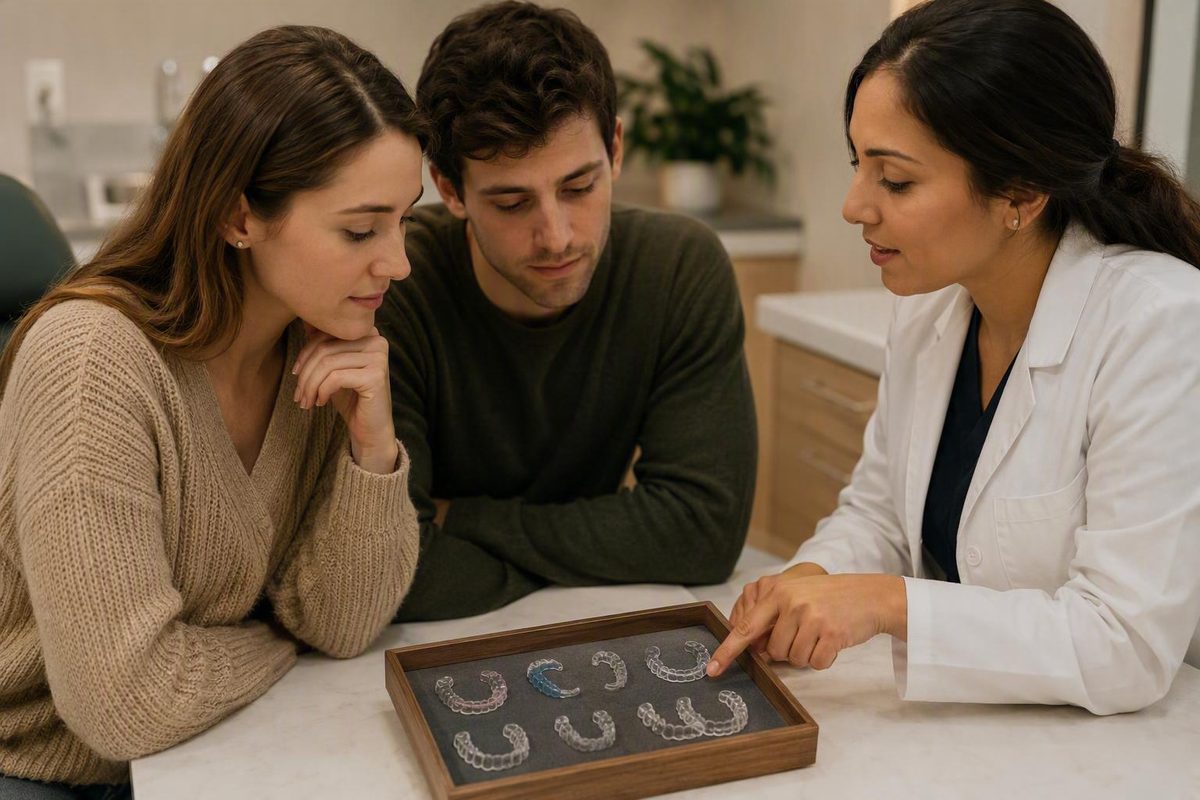
Replacement retainer costs at a glance
A cautious budget for many provider-supplied replacement retainers is about $100–$550 per arch. That is a broad planning band, not a maximum: complete bonded-retainer replacement can reach approximately $600 per arch, while branded packages and higher-priced practices may quote more. “Per arch” means either the upper teeth or the lower teeth—not both. These figures come from selected provider-published estimates rather than an independently validated national average. Compare the published per-arch estimates from Harris Orthodontics.
The most useful working ranges are:
| Retainer type or service | Estimated price per arch | Estimated price for two arches | Important qualifications |
|---|---|---|---|
| Clear plastic or Essix retainer | $100–$300 | $200–$600 | Selected provider estimates support this planning range, although some practices publish substantially higher fees. Confirm whether records, fitting, and follow-up are included. Tooth by Tooth Orthodontics publishes these per-arch estimates. |
| Hawley retainer | $150–$350 | $300–$700 | A removable wire-and-acrylic appliance. Some damaged Hawley retainers may be adjustable or repairable after professional assessment. |
| Complete bonded-retainer replacement | $250–$600 | Do not automatically double without an examination | Scope can differ by arch and number of teeth. Removal, preparation, new wire, bonding, and follow-up may not all be included. Hulse Orthodontics lists bonded-retainer work at up to $600 per arch. |
| Limited rebonding of a permanent retainer | One practice estimates $100–$250 for one tooth | Not applicable | This is a limited repair, not complete wire replacement. |
| Branded or multiple-retainer package | Package-specific | Package-specific | One practice lists four Vivera retainers at $400–$1,200. Package terminology must be checked carefully because “retainers” and “sets” may represent different quantities. |
These ranges combine selected estimates from orthodontic practices that use different pricing units and include different services. They should not be read as statistically representative national prices. The businesses publishing the figures may also sell the appliance or clinical care being discussed.
The biggest source of confusion is the meaning of “one retainer” or “a set.” Depending on the quote, that wording can mean:
- One upper appliance
- One lower appliance
- One upper and one lower appliance
- Two appliances for the same arch
- Several backup appliances
- A package including records, fitting, or follow-up
- Appliance fabrication only
Do not double a quote until you know it is per arch. Conversely, do not assume that a price labeled simply “retainer” includes both arches.
Two cited mail-order sellers advertise clear upper-and-lower sets at $139 and $140, but those are vendor-specific displayed prices—not market averages, clinical-service quotes, or guaranteed checkout totals. Taxes, shipping, optional impression materials, scan storage, additional sets, and expedited processing may change the amount due. ClearRetain displays the $139 sale price and its checkout qualifications.
The simplest budgeting rule is:
Identify the retainer type, confirm the arches and number of physical appliances, and then ask which clinical and delivery services are included.
Why two replacement quotes can be hundreds of dollars apart
Two quotes may appear to cover the same retainer while describing different products and services. A price for one clear lower retainer is not directly comparable with a package containing upper and lower appliances, an examination, professional scans, fitting, adjustments, and a remake policy.
The main cost variables are:
- Retainer type: Clear plastic, Hawley, bonded, and branded systems use different designs and fabrication processes.
- Number of arches: Upper and lower appliances are often billed separately.
- Number of appliances: A package may contain one appliance, one upper-and-lower set, duplicate appliances for one arch, or several backups.
- Material or brand: Standard clear plastic and branded multiple-retainer systems may have different prices.
- Provider and laboratory: Each practice or laboratory sets its own fees and inclusions.
- Location: Local costs and pricing practices can affect a quote, but the available evidence does not establish a reliable city-versus-rural pricing formula.
- Case requirements: A straightforward remake differs from a case involving tooth movement, restorations, a damaged fixed wire, or an appliance that no longer fits.
- Urgency: Rush laboratory processing or expedited shipping can increase the price.
- Available records: A usable digital scan, model, or compatible mold may reduce the work required.
- Repair needs: Adjusting or rebonding an existing appliance is not the same service as fabricating a new one.
What may be inside the final bill
A complete replacement process can involve:
- An examination or consultation
- X-rays, if the provider considers them necessary
- A digital scan or physical impression
- Additional trays or impression material
- Laboratory design and fabrication
- Removal of an old bonded wire
- Tooth preparation and bonding
- An in-office fitting
- Initial adjustments
- Follow-up appointments
- Remakes under specified conditions
- Shipping and taxes
- Digital-record or scan storage
- Expedited processing or delivery
Some offices combine most of these services into one appliance fee. Others bill the visit, records, fabrication, fitting, and adjustments separately. Orthodontic Experts states that a quoted fee may or may not include the examination, scan or impression, fitting, adjustments, remakes, and follow-up. Its replacement-cost guide explains these possible inclusions.
A replacement can cost roughly as much as a newly made retainer because much of the original workflow may be repeated. The provider may need to assess the current tooth position, capture a new scan or impression, arrange fabrication, check the finished appliance, and adjust the fit.
Existing records can sometimes simplify the process. If a practice retains a recent, usable digital scan—or its laboratory accepts a compatible physical or digital model—it may be possible to avoid a new impression or reduce the fee. Reuse is not automatic. The record must remain clinically appropriate and compatible with the provider’s fabrication process.
Normalize every quote before comparing it
Convert each quote to the same unit:
- Same retainer type
- Same number of arches
- Same number of physical appliances
- Same record requirements
- Same fitting and follow-up
- Same remake or warranty terms
- Same delivery speed
If Office A charges per arch and Office B quotes an upper-and-lower bundle, calculate Office A’s two-arch total before comparing them. Then add any separately billed examination, scan, fitting, or rush service.
Do not assume that a practice in a large city will necessarily cost more than one elsewhere. Location can influence pricing, but the selected provider estimates do not support a dependable regional multiplier. A current, itemized quote is more useful than a broad geographic assumption.
Costs and trade-offs by retainer type
The least expensive appliance today is not necessarily the least expensive choice over several years. Upfront price, repairability, likely replacement frequency, fit, visibility, and the number of included backups can all affect value.
Clear or Essix retainers
Clear retainers are removable plastic appliances molded over the teeth. Selected provider estimates support a planning range of about $100–$300 per arch, or $200–$600 for upper and lower when each arch is billed separately. Some practices publish much higher office-level figures; Hulse Orthodontics, for example, lists approximately $350–$650 for clear retainers. Its pricing guide presents both the higher practice estimate and the lower provider-published range.
Clear appliances often have a lower published unit-price estimate than other types. However, provider and seller sources generally describe cracked, distorted, or worn clear plastic as less repairable than a Hawley appliance, making a remake more likely. This is not a diagnosis for any particular appliance; suitability should be assessed by a dentist or orthodontist.
Published lifespan estimates vary substantially and should not be treated as a guaranteed schedule. Grinding, heat exposure, handling, hygiene, material, fit, and wear patterns may all affect how long an appliance remains usable.
When comparing clear-retainer options, consider:
- The price per physical appliance
- Whether one or both arches are needed
- Whether a backup is included
- The provider’s remake policy
- Your history of losing, cracking, grinding, or warping retainers
- Whether new records are required for later replacements
Hawley retainers
A Hawley retainer is a removable appliance combining an acrylic section with wire. The selected provider estimates support a planning range of about $150–$350 per arch, or $300–$700 for two separately billed arches. Becker Orthodontics publishes a comparable per-arch range and describes the design as adjustable.
The potential financial advantage is not necessarily a lower initial price. Some Hawley retainers may be adjusted or repaired when the damage is limited and the appliance still corresponds to the current tooth position. Whether that is appropriate requires professional inspection.
Hawley retainers are often described by providers as longer-lasting than clear plastic appliances, but no individual lifespan is guaranteed. Wire damage, acrylic damage, fit changes, grinding, handling, and hygiene all matter. Their visible wire and greater bulk may also affect the wearer’s preference.
Bonded or fixed retainers
A bonded retainer is a wire attached behind the teeth. Complete replacement is estimated by selected practices at about $250–$600 per arch. That range should not be confused with the price of rebonding one detached point.
“Bonded-retainer work” is not one standardized procedure. A quote might cover:
- Rebonding one detached area
- Repairing or replacing part of a wire
- Removing the existing wire
- Cleaning and preparing the teeth
- Fabricating or selecting a new wire
- Bonding the wire across several teeth
- Checking the bite and bonds
- Follow-up care
Ask the provider to specify which steps, teeth, and arch the price covers. An intact wire that has detached at one point may sometimes be rebonded, while a broken or incorrectly positioned wire may require different work. That distinction can only be made through clinical assessment.
Vivera and other branded or multiple-retainer packages
Vivera is a branded removable-retainer product associated with Invisalign. One orthodontic practice lists four Vivera retainers at $400–$1,200, while Invisalign separately states that an initial order can contain up to four sets. These are not necessarily equivalent quantities: “four retainers” may not mean the same number of physical appliances as “four sets,” and neither statement establishes a universal package price. Invisalign describes its order and coverage considerations without publishing a general replacement price.
A multiple-appliance package may be useful if the extra appliances are genuine backups and remain appropriate for the same tooth position. Its value depends on:
- The number of arches represented
- The number of physical appliances
- Whether every appliance is made from the same records
- How unused appliances must be stored
- Whether future dental work or tooth movement could affect fit
- Whether fitting, follow-up, or replacement guarantees are included
The better long-term comparison is:
Upfront cost + likely replacement frequency + repairability + included backups + clinical services.
Because published lifespan estimates vary widely, this framework is more defensible than claiming an exact annual cost.
Repair, rebond, or replace?
Whether repair is appropriate depends on the appliance, the damage, current tooth position, and a professional examination. The following framework is for preparing questions, not diagnosing the problem at home.
| Problem | Question to ask | Possible outcome |
|---|---|---|
| Lost removable retainer | Are usable records still available? | A new appliance is generally needed because there is nothing to repair. |
| Cracked clear retainer | Has the appliance lost its shape or strength? | Provider sources describe damaged clear plastic as less commonly repairable, so a remake may be recommended. |
| Warped or distorted clear retainer | Does it still seat normally? | Professional assessment and new records may be needed. |
| Damaged Hawley retainer | Are the wire or acrylic repairable, and does the appliance still match the teeth? | Adjustment or repair may be possible; otherwise, replacement may be recommended. |
| Bonded wire detached at one point | Is the existing wire intact and correctly positioned? | Limited rebonding may be possible. |
| Broken bonded wire | Can any part be retained, or is complete replacement required? | The answer depends on the wire, bonds, tooth surfaces, and affected teeth. |
| Retainer no longer fits | Have the teeth, dental work, or appliance changed? | An examination may be needed before replacement. |
Tooth by Tooth Orthodontics estimates $100–$250 to rebond a permanent retainer at one tooth, compared with $250–$500 per arch for complete bonded-retainer replacement. These are one practice’s estimates, not universal fees. Its guide distinguishes limited rebonding from complete replacement.
Before approving bonded-retainer work, ask:
- Is this only a rebond of the existing wire?
- How many teeth are included?
- Is removal of old bonding material included?
- Will the existing wire remain?
- If not, is a new wire included?
- Does the fee cover preparation, bonding, bite checks, and follow-up?
- What happens if another section detaches shortly afterward?
When the appliance no longer fits
A replacement retainer is passive: it is made to hold the tooth position represented by its scan or impression. It is not intended to correct meaningful movement.
If an old appliance no longer seats properly, ordering a replacement from an old model may not address the problem because that model may represent a tooth position that no longer exists. A new impression, meanwhile, captures the current position—which may differ from the position achieved at the end of orthodontic treatment.
Contact a dentist or orthodontist, particularly when there is apparent movement, substantial discomfort, a damaged fixed wire, loose teeth, decay or gum concerns, or recent dental work. Orthodontic Experts notes that shifted teeth may sometimes require corrective aligners or braces before a new passive retainer is made. Its clinical guide explains this distinction.
Repairability and treatment suitability cannot be determined from price alone. They require assessment of the appliance, teeth, bite, and oral health.
Orthodontist versus mail-order replacement
There are three broad replacement channels:
- A dentist or orthodontist, generally using an in-office examination and professional scan or impression
- An online laboratory, generally using impressions taken by the customer at home
- A laboratory or provider using an existing compatible model or digital record
A lower mail-order price does not automatically represent an equivalent service. Likewise, a higher office quote does not prove that every clinical service is included. Compare what is actually delivered.
Advertised mail-order examples
SportingSmiles lists $140 for two clear retainers, configured as one upper and one lower, two uppers, or two lowers. Its listing says the price includes an at-home impression kit, U.S. shipping, a storage case, and a limited warranty. Optional charges shown include additional impression supplies, extra sets, scan storage, and expedited processing. The seller also lists an emergency service at $345, with delivery promised in six to seven business days. These are seller-controlled listings, not independently verified market benchmarks. Review the SportingSmiles listing and optional charges.
ClearRetain displays a $139 sale price for one upper-and-lower clear-retainer set made from customer-taken impressions. Its page says shipping and taxes are calculated at checkout, extra impression material is optional, and product-specific remake or refund conditions apply. Because this is a dynamic sale price, it should be confirmed before ordering.
Service differences to compare
| In-office replacement may include | Mail-order replacement may center on |
|---|---|
| Examination of tooth position and oral health | At-home impression kit |
| Professional digital scan or impression | Customer-taken impression or submitted model |
| Assessment of whether an old record remains suitable | Fabrication from the submitted record |
| Evaluation of movement or bonded-wire damage | Removable clear-retainer production |
| In-person fitting and adjustment | Shipment of the finished appliance |
| Follow-up for fit problems | Seller-specific support, warranty, or remake process |
| Advice about repair versus replacement | Product-specific fabrication services |
Mail-order and clinical prices should not be compared until the arches, number of appliances, records, fitting, follow-up, shipping, taxes, and remake terms have been matched.
Seller statements that online retainers are identical to clinician-provided appliances, more durable, or a fixed percentage cheaper should not be treated as independently established facts. The supplied evidence does not establish equivalent safety, fit quality, durability, or failure rates between the two channels.
Price-only shopping is especially limited when the retainer does not fit, teeth appear to have moved, a bonded wire is damaged, teeth feel loose, or there are decay, gum concerns, or significant restorations. ClearRetain itself advises customers with crowns, bridges, veneers, fillings, loose teeth, or compromised dental conditions to consult a dentist before using customer-taken impressions. That is seller guidance rather than independent clinical evidence, but it illustrates why the headline price may not answer whether a mail-order process is appropriate.
Four realistic budgeting scenarios
These scenarios turn the selected provider ranges into working budgets. They do not assign invented amounts to examinations, scans, adjustments, or rush service.
Scenario 1: One clear retainer for one arch
Price unit: One clear upper or one clear lower appliance Starting estimate: Approximately $100–$300, based on selected per-arch provider estimates. Harris Orthodontics publishes clear-retainer estimates extending from $150 to $500 per arch.
Possible separate charges include an examination, scan or impression, fitting, adjustment, remake, follow-up, or rush processing.
Ask:
- Is this price for the upper or lower arch?
- Does “one retainer” mean one physical appliance?
- Is an examination required?
- Is the scan or impression included?
- Are fitting and adjustments included?
- What happens if the appliance does not fit?
- What is the final estimated amount due?
Scenario 2: Upper-and-lower clear retainers from a provider
Price unit: One upper plus one lower clear appliance Starting estimate: Approximately $200–$600, calculated from the selected $100–$300 per-arch planning range.
This simple doubling does not apply if the provider offers a bundle, publishes a higher practice-specific fee, or includes multiple backup appliances.
Ask:
- Is this a two-arch package or two per-arch charges?
- How many physical appliances will be delivered?
- Are both made from the same scan?
- Are examination, records, fitting, and follow-up included?
- Is backup-set pricing available?
- What remake terms apply if only one arch fits?
Request wording such as “one upper appliance and one lower appliance” instead of relying on the word “set.”
Scenario 3: Upper-and-lower Hawley retainers
Price unit: One Hawley appliance for each arch Starting estimate: Approximately $300–$700, based on two arches at $150–$350 each.
A practice may quote outside this range. If an existing Hawley retainer remains suitable for the current tooth position, professional adjustment or repair could cost less than complete replacement.
Ask:
- Is each arch billed separately?
- Does the price include the custom wire and acrylic work?
- Can either existing appliance be repaired?
- Are fitting and adjustments included?
- If only one arch is damaged, is replacing both necessary?
- Is there an upper-and-lower package price?
Scenario 4: Bonded-retainer work
Price unit: The exact bonded-wire procedure Limited-repair example: Approximately $100–$250 to rebond one tooth, based on one practice estimate Complete replacement estimate: Approximately $250–$600 per arch
The difference can be hundreds of dollars because attaching an intact wire at one point is not equivalent to removing and replacing a complete appliance.
Ask:
- Is the wire intact and correctly positioned?
- How many teeth need rebonding?
- Is old adhesive removal included?
- Is a new wire included?
- Does the fee cover removal, preparation, bonding, bite checks, and follow-up?
- Is the charge per tooth, per repair, or per arch?
Do not approve a vaguely described “permanent retainer replacement” without a written scope.
Separate mail-order comparison
The two cited upper-and-lower clear sets are advertised at $139 and $140 before applicable extras. These prices may cover two physical appliances, making them appear much lower than two office per-arch fees. The comparison remains incomplete until it accounts for clinical assessment, impression method, fitting, follow-up, shipping, taxes, extra supplies, rush processing, and remake terms.
Ask:
- Does the displayed price include one upper and one lower?
- Are shipping and taxes included?
- How many impression attempts or supplies are included?
- What happens if the impression is unusable?
- Is there a refund, a remake, or both?
- Are shipping or material costs excluded from the guarantee?
- What is the standard delivery time?
- What does expedited service cost?
An advertised appliance price and an itemized clinical-service quote are different products until their units and inclusions match.
Insurance, treatment contracts, and tax-advantaged funds
Provider sources commonly describe later replacement retainers as out-of-pocket expenses, especially after loss or damage. Coverage nevertheless varies by plan.
The initial retainer may have been included in the original braces or clear-aligner fee. Inclusion depends on the treatment agreement, and later replacements may be handled differently. Ask the original office whether the contract includes:
- The first upper-and-lower set
- A specified number of replacements
- Discounted replacements for a limited period
- A protection or replacement plan
- Stored scans or models
- Backup appliances
- Fitting and follow-up
Insurance-verification checklist
Ask the insurer or plan administrator:
- Is there a benefit for a replacement orthodontic retainer?
- Does coverage differ for removable and bonded retainers?
- Are loss, accidental damage, ordinary wear, or pet damage excluded?
- Does the deductible apply?
- What coinsurance applies?
- Is the expense subject to an orthodontic lifetime maximum?
- Has that maximum already been used?
- Must the provider be in network?
- Is preauthorization or predetermination required?
- Are there frequency limits?
- What procedure code, treatment note, or proof of damage is required?
- Is repair or rebonding covered differently from replacement?
Insurance coverage and HSA/FSA eligibility are separate questions. Several provider sources describe prescribed retainers as potentially eligible for HSA or FSA payment, but reimbursement depends on the account, documentation, and applicable rules. San Diego Smile Pros also mentions dental discount plans as a possible avenue; any discount must be confirmed rather than assumed. See its discussion of insurance, HSA/FSA funds, and discount plans.
Phone script for the insurer
“I need a replacement orthodontic retainer. Can you check whether my plan covers replacement due to loss, damage, or wear? The quote covers [one upper arch / one lower arch / both arches] and includes [examination, scan, fabrication, fitting, repair, or rebonding]. Please tell me whether a deductible, coinsurance, orthodontic lifetime maximum, network rule, preauthorization, frequency limit, or documentation requirement applies.”
Phone script for the orthodontic office
“Before I schedule, can you confirm whether my original treatment agreement includes a replacement-retainer benefit? If not, please provide an itemized quote stating the retainer type, number of arches and physical appliances, required records, fitting, adjustments, follow-up, and any procedure code or documentation needed for insurance or HSA/FSA reimbursement.”
Do not rely on general statements that insurance always covers an initial set or never covers replacements. The controlling documents are the treatment agreement and the specific benefit plan.
How to get an accurate, comparable quote
A short written request can prevent confusion over per-arch pricing and missing services.
Copy-ready replacement-retainer quote checklist
Appliance and quantity
- What type of retainer is being quoted?
- Is the fee for one upper arch, one lower arch, or both?
- Does “two retainers” mean upper and lower or two copies for one arch?
- Are backup appliances included?
- For a bonded retainer, which arch and how many teeth are included?
Clinical services and records
- Is an examination or consultation included?
- Are X-rays required, and are they included?
- Is a digital scan or physical impression included?
- Is laboratory fabrication included?
- Is the in-person fitting included?
- Are initial adjustments and follow-up visits included?
- What happens if the appliance does not fit?
- Under what conditions is a remake included?
Existing records
- Do you still have my digital scan, physical model, or mold?
- Is it compatible with your current laboratory?
- Is it recent and clinically appropriate to reuse?
- Would reuse reduce the price or turnaround?
- How long do you retain records?
- Is there a fee to retrieve, transfer, or store them?
Repair versus replacement
- Can my Hawley retainer be adjusted or repaired?
- Can my bonded wire be rebonded rather than replaced?
- Does a complete bonded-retainer fee include old-wire removal, tooth preparation, a new wire, bonding, bite checks, and follow-up?
- If my clear retainer is cracked, does the provider recommend a complete remake?
Delivery, policies, and final price
- What is the standard turnaround?
- What expedited option is available?
- Are rush processing and expedited shipping separate charges?
- Are shipping and taxes included?
- Are extra impression materials included?
- What warranty or remake policy applies?
- Are material or shipping costs excluded from a refund?
- Is backup-set pricing available?
- What is the final estimated amount due?
There is no universal turnaround. San Diego Smile Pros reports a typical traditional-office timeframe of one to two weeks, while emphasizing that timing varies. Its guide provides that office-specific estimate.
SportingSmiles separately advertises six-to-seven-business-day delivery for its $345 emergency service. That is a seller-specific promise, not a general timeline for other laboratories or practices.
Describe poor fit or apparent movement before ordering. Those facts may change the service from a straightforward passive remake to an examination, new records, repair, or corrective treatment.
The final comparison formula is:
Same retainer type + same arches and physical appliances + same included clinical services + same delivery speed.
Aligner Source provides general information rather than individual diagnosis or treatment planning. Final decisions about repair, replacement, rebonding, or correction of tooth movement belong with the treating dentist or orthodontist, consistent with Aligner Source’s informational-use limitation.
Frequently asked questions
Is a replacement-retainer price usually for one arch or both?
Many clinical estimates are quoted per arch, meaning upper or lower only. If both arches need replacement, a provider may charge approximately twice the one-arch price unless it offers a bundle.
Terms such as “retainer,” “set,” and “two retainers” are not standardized pricing units. Ask the provider to identify the arches and number of physical appliances in writing.
Can an orthodontist reuse my old mold or digital scan?
Sometimes. A saved digital scan, physical model, or compatible mold may be reusable if the provider considers it accurate, clinically appropriate, and compatible with the current fabrication process. Reuse may remove a step or reduce the fee, but it is not guaranteed.
Ask how long the office stores records and whether retrieval, transfer, or storage fees apply.
Does dental insurance cover a lost or broken retainer?
It depends on the plan. Provider sources often describe later replacements as out-of-pocket expenses, but some plans may contribute. Loss or damage exclusions, deductibles, coinsurance, orthodontic lifetime maximums, network restrictions, preauthorization, documentation requirements, and frequency limits may affect reimbursement.
Also check the original orthodontic agreement. It may include an initial set, backup appliances, limited replacement coverage, or a reduced replacement fee even when insurance does not pay.
How long does it take to get a replacement retainer?
Turnaround varies with the provider, laboratory, record requirements, retainer type, shipping, and urgency. An office process may involve an examination, scan or impression, fabrication, fitting, and adjustment. A mail-order process may involve shipping the impression kit, returning the impression, laboratory production, and delivery of the finished appliance.
Ask for both the standard and expedited timelines, including all rush charges. Do not assume that an advertised delivery promise includes impression transit, clinical assessment, or remake time.
What should I do if my old retainer no longer fits?
Contact a dentist or orthodontist and explain whether the appliance is tight, only partially seated, visibly distorted, or associated with apparent tooth movement.
A passive replacement retainer holds the position represented by its scan or impression; it does not correct meaningful movement. An examination can determine whether the next step is adjustment, new records, a passive replacement, bonded-wire repair, or corrective orthodontic treatment.
For budgeting, start with the per-arch range for the relevant retainer type. Multiply only after confirming that both arches need replacement, then add any separately quoted records, fitting, repair, delivery, or follow-up. Request an itemized quote, check the original treatment contract and insurance benefits, and seek an orthodontic assessment if the appliance no longer fits or the teeth appear to have moved.